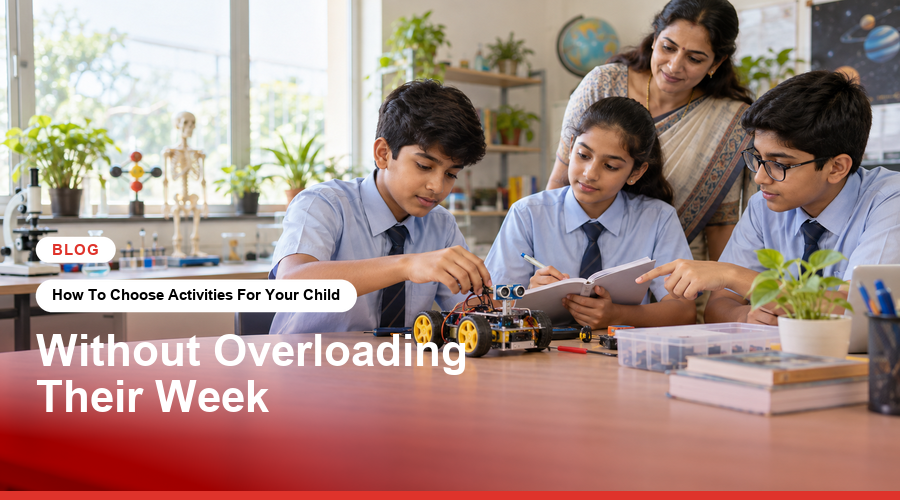
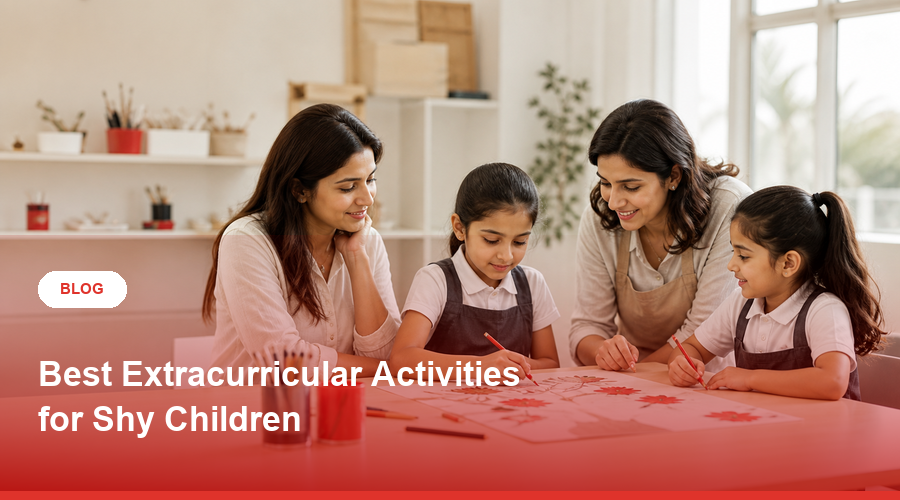
Your child watches a new group before joining it. They speak freely at home, yet answer an unfamiliar adult with one word. At a birthday party, they stay close to you for the first twenty minutes, then slowly begin to play. You may call this shyness. Other parents may tell you that football, drama or martial arts will ‘bring them out of their shell’. The activity brochure may make every option sound ideal.
The real question is not which activity makes a shy child more outgoing. It is which activity gives your child a safe reason to take one small step beyond what already feels comfortable. That answer depends on temperament, interest, group size, the coach and the pace of the programme. A child who loves movement may grow through karate. A child who builds for hours may connect more easily through robotics or chess. A child who tells stories at home may enjoy drama, but only after trust has formed.
This is the clear-eyed version for Dubai parents. It explains what shyness actually means, how different activities may help, what warning signs to notice and how to run a four-week trial without turning confidence into another performance target.
What Is Shyness in Children?
Shyness is not one fixed type of child. It often means a child needs more time before they feel safe enough to speak, join or perform. The American Academy of Pediatrics describes many shy children as slow to warm up. They may do well in friendships and group settings once the first period of adjustment has passed.
That is different from introversion. An introverted child may enjoy people but need quiet time after a busy day. They may prefer one close friend to a large group. They do not need to become more social to be healthy. They need social experiences that respect how they regain energy.
Shyness is also different from social anxiety. The UK National Health Service explains that social anxiety is more than ordinary shyness. Fear is strong, lasts for a long time and starts to limit school, friendships or daily life. A child may avoid speaking even when they need help, become very distressed before activities, complain of repeated stomach aches or stop doing things they once enjoyed.
This distinction matters because an extracurricular activity can give a slow-to-warm child repeated, manageable practice. It is not a treatment for severe anxiety. If fear is persistent or is getting in the way of daily life, speak with your child’s teacher and a qualified health professional.
How Can Extracurricular Activities Help a Shy Child?
A useful activity does not force a personality change. It creates a bridge between something the child enjoys and a social situation they might otherwise avoid.
A 2021 systematic review of interventions for shyness in school-aged children found that helpful programmes often used play, modelling, reinforcement, social-skills practice and gradual exposure. Many took place in groups outside the normal classroom. The important point is not that every club acts as an intervention. It is that confidence tends to grow through small, repeated experiences rather than one dramatic push.
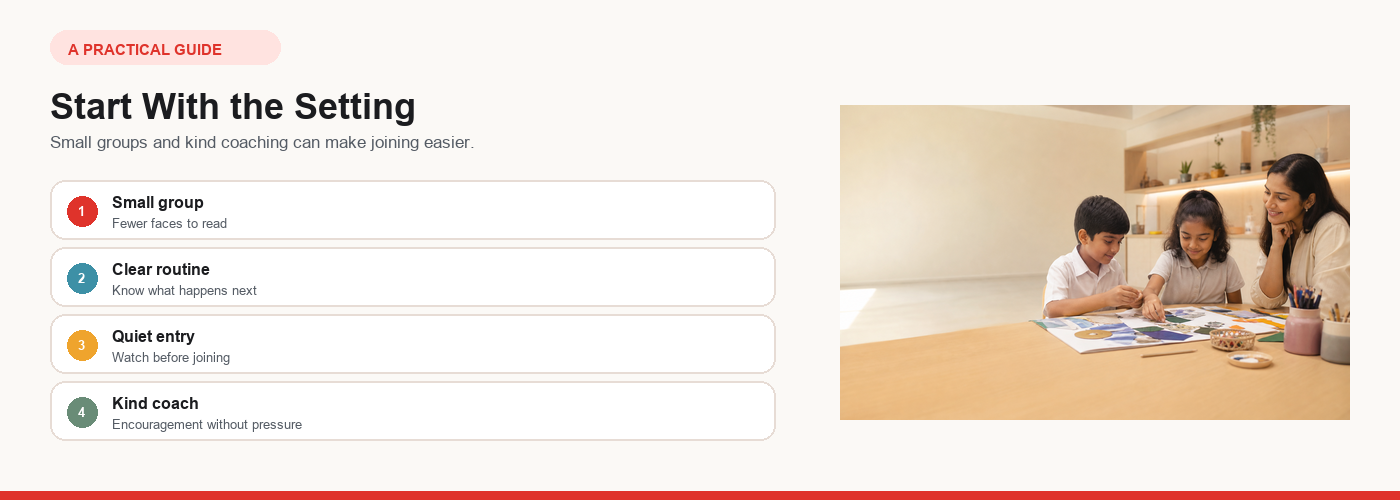
The strongest activities often contain five features:
- A shared purpose – Children can talk about the ball, the drawing, the robot or the music instead of trying to ‘make conversation’ from nothing.
- Predictable structure – A clear start, routine and finish reduce the energy spent guessing what happens next.
- A manageable social dose – The child interacts with one partner or a small group before facing a whole team or audience.
- Visible progress – A new stroke, pattern, move or solution gives the child evidence that effort leads somewhere.
- A calm adult – A coach who notices without pressuring can make the same activity feel completely different.
Dubai’s Knowledge and Human Development Authority, or KHDA, now places communication, collaboration, resilience and decision-making within its Skills for Life work. Its guidance notes that these skills develop through lessons, projects, leadership opportunities, wellbeing initiatives and extracurricular activities. The goal is not loudness. It is the ability to take part, make choices and recover when something feels difficult.
Start with Strengths, Not with What You Want to Fix
Parents often begin with the problem: ‘My child will not speak in a group.’ A strengths-first approach begins elsewhere: ‘What does my child already choose when nobody is judging them?’
This is more than positive language. Interest reduces the number of new demands a child must handle at once. If the activity is familiar or deeply appealing, the child can spend more energy learning the social part. UNICEF’s parenting guidance makes a similar point: enjoyable activities that offer a sense of mastery can build confidence because the child experiences competence, contribution and progress.
Watch your child for one ordinary week. Notice when they become absorbed, when they take initiative and when they explain something without being asked. Then match the activity to that strength.
- If your child climbs, balances or copies movement, consider gymnastics, swimming, martial arts or tennis.
- If they draw, build or sort, consider art, craft, chess, coding or robotics.
- If they sing, imitate characters or invent stories at home, consider music, dance, puppetry or a gentle drama group.
- If they care for animals, plants or younger children, consider nature clubs, gardening or age-appropriate community service.
- If they enjoy rules and patterns, consider chess, table tennis, archery-style target games where available, or structured skill clubs.
How Can Extracurricular Activities Help a Shy Child?
Daily independent reading, even just 15 to 20 minutes of a book a child has chosen themselves, is one of the most consistently supported habits in literacy research. It builds vocabulary, comprehension, and general knowledge in a way that compounds over years, far beyond what reading assigned for homework alone achieves.
The key detail researchers emphasise is choice: reading a child actually wants to do produces stronger gains than reading assigned purely as a task, because the child is more likely to sustain the habit and engage attentively with the material.
For the Child Who Takes Time to Warm Up
This child watches carefully, copies after others and may refuse the first invitation. They often do well in an activity with a repeated routine and permission to observe.
Good starting points may include swimming, gymnastics, art, chess, beginner coding or a small music group. Ask whether the instructor allows a child to watch part of the first session or join beside one familiar peer. Avoid programmes that treat instant participation as the only sign of success.
For the Quiet Child Who Loves Movement
Some children speak little in new settings but communicate well through movement. An individual sport within a group can give them belonging without constant conversation.
Swimming, tennis, athletics, skating, gymnastics and some martial arts can work well because instructions are clear and progress is visible. The World Health Organization notes that regular physical activity supports self-esteem, social integration, motor development and wellbeing. Yet the activity still needs the right environment. A loud, highly competitive class can overwhelm a child who would thrive in a calmer one.
For the Child Who Loves Building and Solving Problems
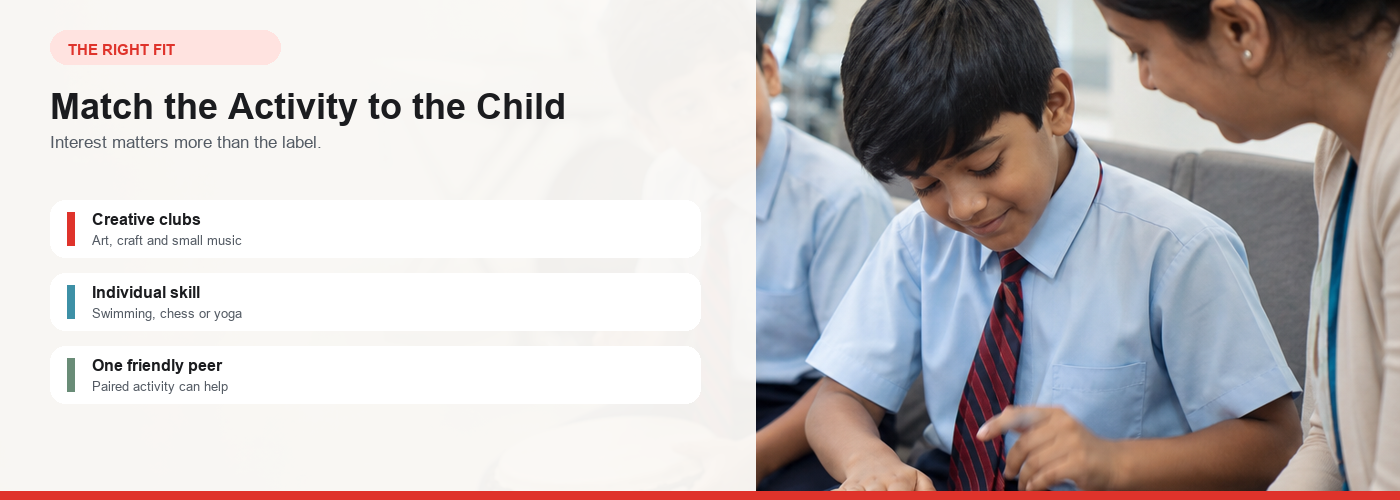
A child who loves puzzles or construction may connect most naturally when everyone is working on the same task. Robotics, coding, chess, design, craft and science clubs create conversation with a purpose: ‘Can you pass that piece?’ or ‘What if we try this?’
These clubs can suit a child who finds open-ended social situations tiring. Check that the programme includes some paired work. A room where every child works alone may build skill but offer little gentle social practice.
For the Child Who Is Creative at Home but Shy in Groups
A child may perform whole scenes for the family and then freeze when a teacher asks their name. Drama, dance or music can help, but the route to the stage matters more than the stage itself.
Look for imaginative games, ensemble work and roles that do not begin with solo performance. Research on arts education shows mixed results for broad claims about social confidence. That is a useful warning. Drama is not a guaranteed cure for shyness. It may help when the child enjoys pretend play and the teacher builds trust before expecting public performance.
For the Child Who Is Comfortable With One Friend
This child is comfortable with one known person but becomes quiet in a crowd. A paired activity can widen the circle without removing their anchor.
Try doubles tennis, partner dance, paired martial-arts drills, chess or a small project club. If possible, let the child attend with one compatible friend for the first few sessions. The friend should be a bridge, not a spokesperson. Ask the coach to address both children directly and rotate partners slowly.
For Children Who Are Sensitive to Noise and Crowds
A large indoor hall, whistles, echo and rapid transitions can look like ‘shyness’ when the real issue is sensory load. The child may participate well in a quiet studio and withdraw in a crowded sports arena.
Consider art, swimming in a smaller class, chess, nature activities, yoga, archery-style focus activities or individual music lessons that later expand into a group. Visit at the actual class time. A calm venue at registration may feel very different when six groups are running at once.
Which Extracurricular Activities Are Best for Shy Children?
Individual Sports within a Group
Swimming, gymnastics, tennis and athletics let a child work on a personal skill while sharing space with others. This can be a gentle first step because success does not depend on speaking quickly or entering an established team.
The limitation is that proximity is not the same as connection. Ask whether the instructor uses partner warm-ups, supportive feedback and simple group rituals. Otherwise, the child may improve physically without gaining much social practice.
Martial Arts
Martial arts may appeal to a shy child because the sequence is ordered, progress is marked and respect is explicit. Reviews show clear physical benefits for children, including balance, coordination, strength and fitness. Claims about confidence and social behaviour are less certain and depend heavily on the instructor, teaching style and group culture.
Choose a programme that teaches self-control, paired respect and calm correction. Avoid one that uses humiliation, shouting or constant comparison as motivation. The name of the martial art matters less than the quality of guidance.
Team Sports
Football, basketball, cricket and similar sports offer belonging, shared goals and repeated contact. They may suit a shy child who already loves the game. They may also be too socially dense as a first step if the group is large, competitive and already formed.
Recent research on shy children and sport suggests that group dynamics matter. High overall participation does not automatically make the experience easier for the shy child. Ask how teams are selected, how mistakes are handled and whether beginners receive meaningful time rather than standing at the edge.
Drama, Dance and Music
Chess, Robotics, Art and Making Clubs
Interest-led clubs create low-pressure conversation and visible mastery. They suit children who prefer depth to speed. They can also reveal leadership that is easy to miss in a noisy classroom: explaining a design, noticing a pattern or helping a partner solve a problem.
The risk is that adults may leave quiet children alone because they look settled. Ask how the facilitator creates collaboration without forcing it. A small shared project is often more useful than simply placing children at the same table.
The Five-Fit Test for Choosing an Extracurricular Activity

- Interest fit: Does your child choose something similar during free time?
- Social fit: Is the group small enough, and can the child begin with a partner?
- Adult fit: Does the coach guide quietly, learn names and respond well to hesitation?
- Routine fit: Are the structure, expectations and transitions predictable?
- Family fit: Can you manage the cost, travel and timing without turning the activity into weekly stress?
How to Trial an Extracurricular Activity Before Committing
- Before week one: Visit the venue, show your child where you will wait and explain the sequence in simple terms. Tell the coach that your child may need time to warm
- Week one: The goal is familiarity. Success may mean entering the room, watching closely or completing one part of the session.
- Week two: Look for one small act of participation: answering the coach, copying a move, passing an object or working beside another child.
- Week three: Notice recovery. Does your child settle faster after initial worry? Do they mention a person, skill or moment with interest?
- Week four: Decide with evidence. Continue if comfort and participation are slowly growing. Adjust the class, time or instructor if interest is present but the setting is wrong. Stop if distress remains intense and there is no sign of recovery.
How to Trial an Extracurricular Activity Before Committing
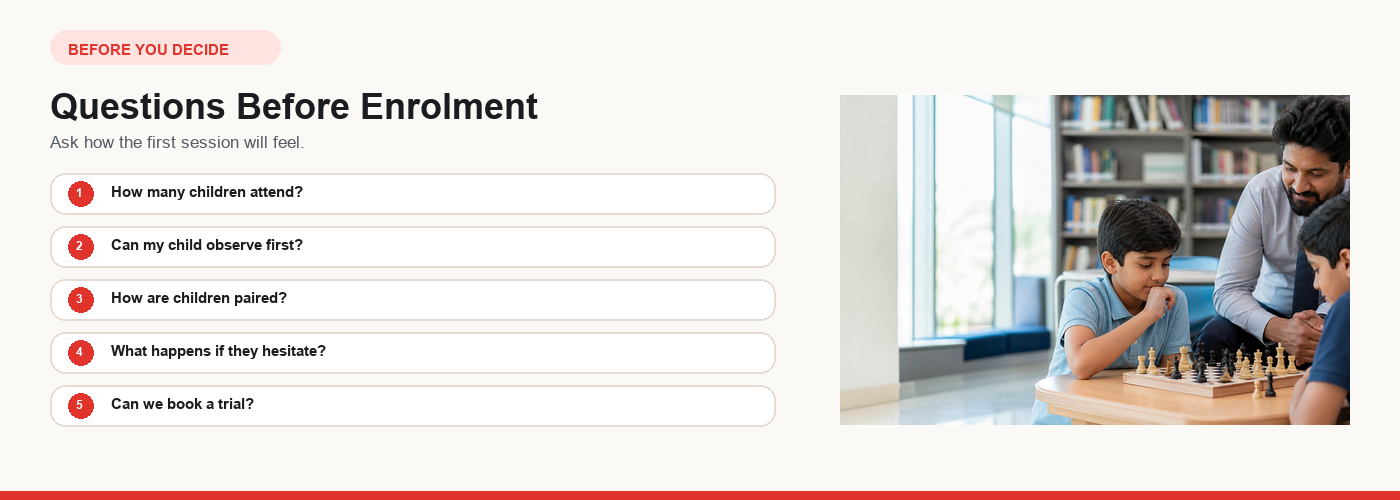
- How many children and adults are in the group?
- Can a new child observe or join gradually during the first session?
- How do you pair children who do not know anyone?
- How do you respond when a child refuses to speak or perform?
- Is public performance required, optional or introduced later?
- How do you update parents without discussing the child in front of others?
- Can we book a trial before paying for the full term?
How Many Extracurricular Activities Should a Child Have?
Shy children are sometimes given several activities at once because parents want faster progress. The result can be a week with no unstructured time and a child who is always preparing for the next social demand.
One well-matched activity is enough to begin. The wider DGS Dubai guide to how extracurricular activities actually work explains why quality, progression and reflection matter more than the length of the activity list. Your child also needs sleep, family time and free play. Confidence grows during recovery as well as effort.
Watch for changes in mood, sleep, appetite and willingness to attend. A child can be nervous and still want to go. That is different from panic, repeated physical complaints or distress that lasts long after the session.
When Should Parents Seek Additional Support for Shyness?
An extracurricular activity should not carry the full weight of your child’s emotional wellbeing. Speak with the school and seek qualified advice if your child’s fear is strong, persistent or getting worse.
Useful warning signs include:
- avoiding school, clubs, celebrations and ordinary family outings;
- being unable to ask an adult for help when needed;
- frequent stomach aches, headaches, sleep problems or panic before social situations;
- distress that affects friendships, learning or family life;
- a sudden change after bullying, relocation, loss or another difficult event. /li>
How Dhruv Global School Dubai Supports Different Child Strengths
Dhruv Global School, Dubai begins with a simple belief: children do not all show ability in the same way. A child who speaks last may be observing most closely. A child who avoids the stage may lead through planning, design, care or quiet persistence.
The school’s stated philosophy draws on multiple intelligences, personalised learning, social and emotional intelligence, yogic values and holistic development. For a shy child, that means confidence should not be reduced to public speaking. It can appear as asking one question, joining one partner, trying again after a mistake or sharing a skill with a small group.
We do not tell every family that one activity is right for every child. The useful question is whether the environment recognises the child’s current strength and offers a next step that is challenging but manageable. Families considering the school should visit, discuss their child’s temperament and ask how activity choices, classroom support and wellbeing practices work together. Our article on yoga and mindfulness in schools explains one part of that wider approach to self-regulation.
Final Thoughts
The best extracurricular activity for a shy child is not automatically drama, football, karate or art. It is an activity where interest is strong enough to support one small act of courage, and where the adult is patient enough to notice it.
Do not choose an activity to replace your child’s personality. Choose one that helps them use the personality they already have: careful, observant, thoughtful, creative or deeply focused. Confidence does not always arrive loudly. Sometimes it looks like entering the room more easily, answering one question or staying for the whole session with a quiet smile.