
The message arrives on a weekday evening: a new coding club, a sports trial, an Olympiad preparation group, a music class. Each opportunity sounds useful. Many parents understandably want to say yes, especially when their child is curious or when other families seem to be doing more. Yet a calendar can become crowded long before anyone notices.
For school-age children, the challenge is not choosing between academics and activities. Both matter. The challenge is creating a week in which homework, movement, friendship, sleep and family time can exist together. An activity should widen a child’s world, not turn every afternoon into a race from one obligation to the next.
This guide offers a clearer way to decide. You will learn what to look for, how to spot overload early and how a school can support genuine holistic development without treating busyness as achievement.
How Many Extracurricular Activities Are Too Many?
Why More Activities Don't Always Mean More Development
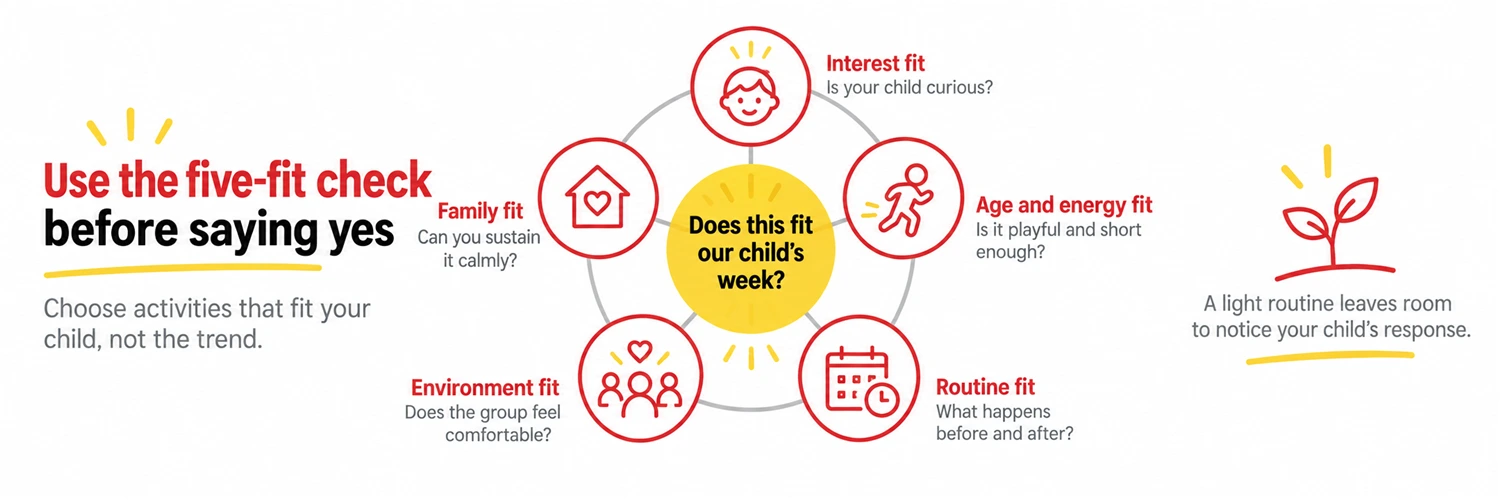
Clubs, sport, music, art and competitions can help a student discover interests and practise commitment. But each commitment also has a cost: changing clothes, travelling, eating late, catching up on homework and shifting attention again. These small demands add up, particularly during examinations or when a child is adjusting to a new class.
The American Academy of Pediatrics notes that routines around meals, homework, play and bedtime help children build organisation. Its parent guidance also warns that an over-scheduled family may crowd out ordinary responsibilities. That does not mean children should avoid activities. It means the activity plan needs to fit the whole family system.
A child does not need a different achievement every day to grow. They need enough repetition to improve, enough rest to return with energy and enough unstructured time to think about what they enjoy. Full stop.
What Does a Balanced Week Look Like for a School Student?
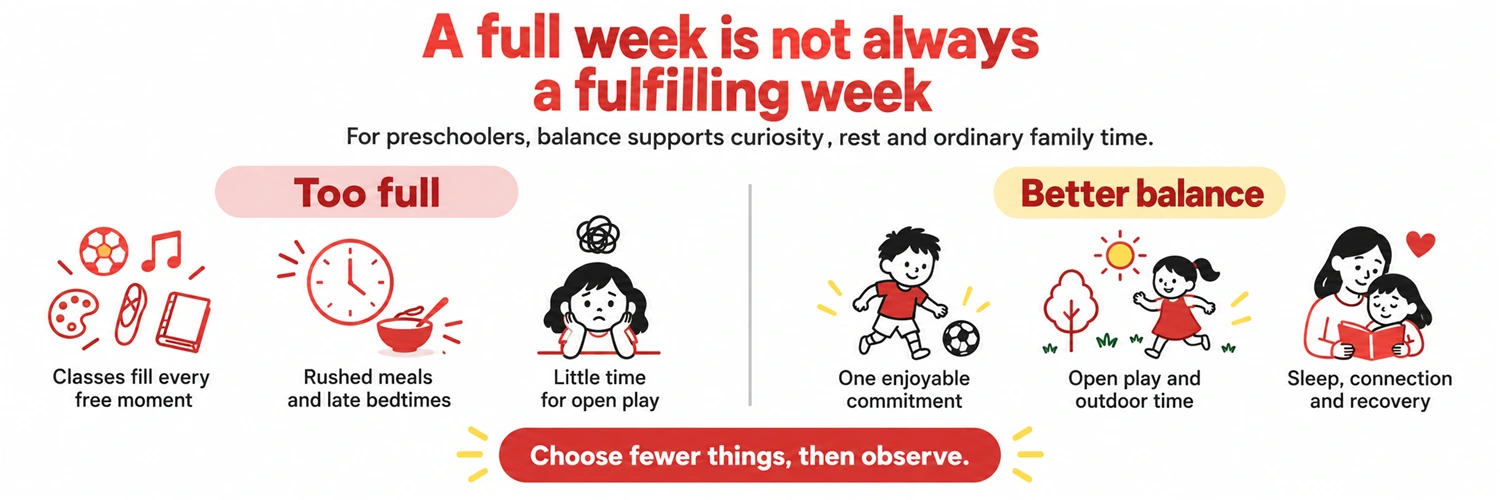
A healthy mix usually has four parts: one or two interests that a child genuinely wants to pursue; regular movement; time for academic responsibilities; and unplanned time. The mix will look different for a Class 3 child exploring football and a Class 9 student preparing for board-focused years. Age is not the only factor, temperament and commute matter too.
Try to distinguish between an activity that is enriching and an activity that is simply another form of pressure. A child can enjoy competitive sport, structured music lessons or advanced robotics. The useful question is whether the child has ownership, understands the commitment and still has enough margin in the week.
The best extracurricular activities create learning through participation, not constant performance.
A useful weekly check: If one more activity means less sleep, no open time or daily rushed meals, the schedule needs a change, not another commitment.
How to Choose the Right Extracurricular Activity for Your Child
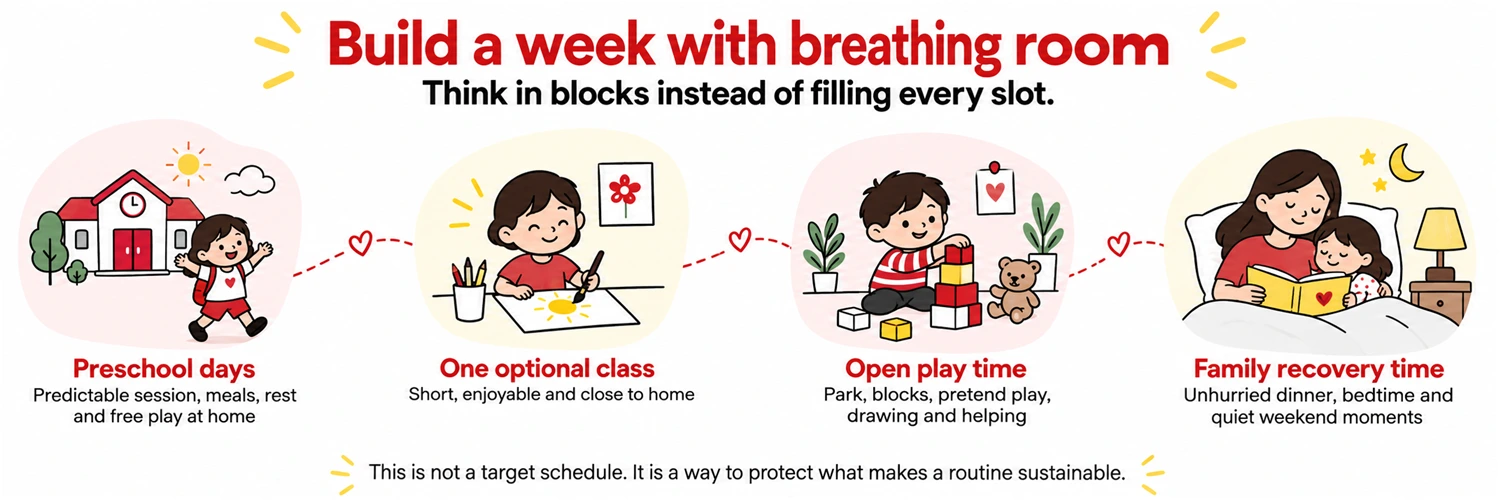
Before you sign up, have one short conversation at home. Ask: Does my child want to try this, or are we choosing it for them? What will this add to the week beyond a certificate? What must move to make room for it? Is the travel time reasonable? And could we pause or stop if the fit is wrong?
Then ask the provider or school practical questions. What is the weekly time commitment including events? Are trials possible? What happens when a student has an examination week? Is participation graded or optional? How are beginners supported? Clear answers help families choose an activity that is demanding in the right way, not demanding in every way.
Begin with a trial mindset. You are not choosing a lifelong identity at the enrolment desk.
Signs Your Child May Be Over-Scheduled
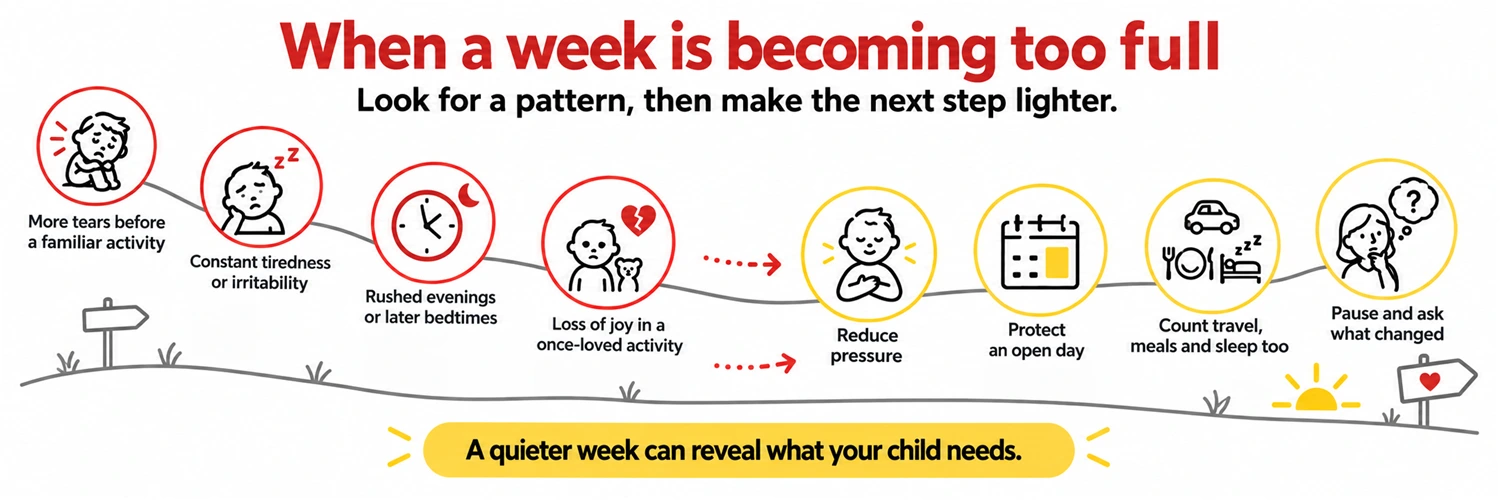
Children rarely announce that their schedule is too full. More often, they show it through patterns: regular morning resistance, irritability after school, a sudden loss of enthusiasm for a formerly loved class, chronic late bedtimes or homework that becomes a nightly conflict. One difficult week is normal. A repeated pattern is worth noticing.
Look at the pattern without blaming the child. A student who refuses practice may be bored, worried about judgement, too tired after school or struggling with the transition between activities. The answer may be a quieter week, a different group, fewer competitions or a simple pause.
Protecting a child’s wellbeing is not giving up on discipline. It is teaching them to recognise limits and make thoughtful choices.
A simple weekly balance check
| Area | Ask yourself | A healthy sign |
|---|---|---|
| Schoolwork | Can homework be completed without a daily late-night rush? | There is time to work steadily and ask for help. |
| Sleep and meals | Does the timetable protect a predictable evening routine? | The child wakes with workable energy most days. |
| Activity | Does the child know why they are doing it? | Interest remains stronger than dread. |
| Open time | Are there spaces with no target to meet? | There is time to relax, read, play or meet friends. |
What Should You Do if Your Child Wants to Quit an Activity?
Use questions that make it safe to be honest. “What part do you look forward to?” is often more useful than “Do you want to quit?” Ask what feels easy, what feels hard and what they would change if they could. Younger children may answer through details: the coach shouts, the bus ride is long or they miss playing with friends.
Avoid using an activity as proof of capability. Phrases such as “You must finish because you started” can be helpful when a child is simply nervous, but not when the commitment is causing consistent distress. Decide together whether the next step is to continue with support, reduce the frequency or stop. That is a real decision-making skill.
A child who feels heard is more likely to take healthy risks later.
How Dhruv Dubai School Approaches Activities
Dhruv Global School, a school with campuses in Nande, Undri and Sangamner, views holistic development as more than adding activities after academic hours. Its philosophy brings music, sports, art and nature alongside classroom learning, giving students multiple ways to explore strengths and interests.
Across its school offering, students can engage with sports, creative pursuits and practical learning experiences. The school’s published sports facilities include swimming, badminton, basketball, football, yoga, table tennis and more, while its co-scholastic roles also span areas such as drama, music, art and craft. The aim is choice with structure—not a one-size-fits-all checklist.
For families comparing the best school in Dubai, this balance is an important question to ask on a campus visit: how does the school help a child participate deeply while staying well? A programme is most valuable when teachers understand the student behind it.
Final Thoughts
The right activity is not always the most prestigious, competitive or popular one. It is the one that helps your child feel capable, interested and connected—while leaving enough room for schoolwork, sleep and ordinary life. Choose fewer things well. Review the routine honestly. Let curiosity, not comparison, lead the way.
FAQs
How many extracurricular activities should a school student do?
Should a child continue an activity they no longer enjoy?
Can activities affect academic performance?
They can support confidence and organisation, but a schedule that consistently cuts sleep or homework time may create pressure. Review the whole week, not just the class itself.