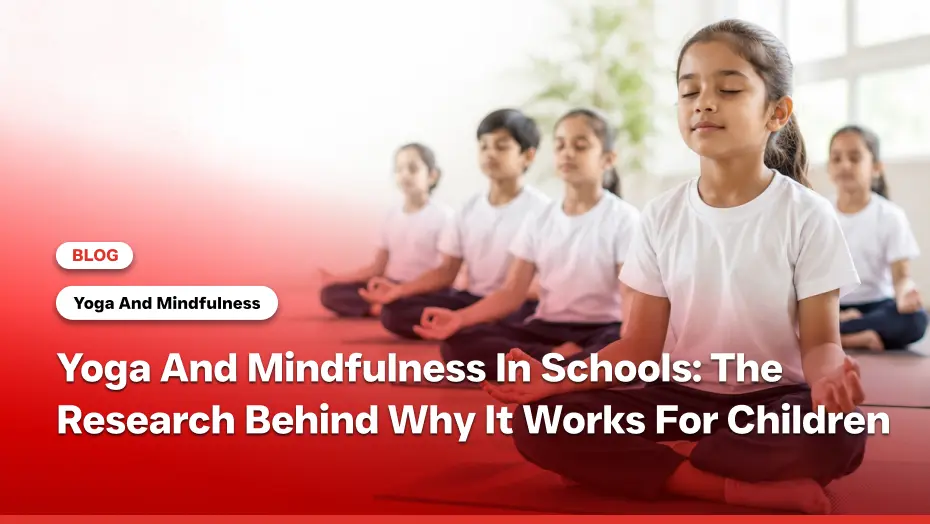
For many Indian parents, yoga needs no research justification. It is a practice woven into the fabric of Indian life, something passed through generations, understood instinctively as good for the body and the mind. The idea of introducing it in schools feels natural, even obvious.
But in the context of Dubai’s international school environment, where academic competition is high, where children are navigating multicultural social landscapes, where exam pressure begins earlier than many parents would like, and where mental health challenges among school-aged children are a documented and growing concern, the question of whether yoga and mindfulness belong in a school timetable needs to be answered with evidence, not tradition alone.
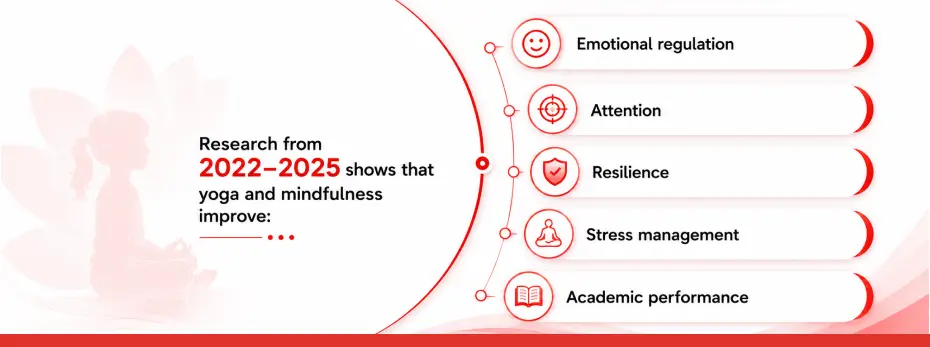
The evidence, it turns out, is substantial and growing. Multiple peer-reviewed studies published between 2022 and 2025 from Stanford, Edinburgh, Frontiers in Education, and the British Journal of Health Psychology, converge on a clear finding: yoga and mindfulness in schools produce measurable improvements in academic performance, emotional regulation, resilience, attention, and mental health, across age groups, across geographies, and in both neurotypical and neurodiverse children.
This blog walks through what that research actually shows, explains the specific mechanisms by which yoga and mindfulness improve learning outcomes, addresses the context of Dubai’s school environment, and explains how Dhruv Global School Dubai integrates yogic values as a genuine educational philosophy, not an afterthought.
What Research Says About Yoga and Mindfulness for Children
In January 2025, the Khaleej Times reported that UAE schools were stepping up wellness support for students ahead of board exams with schools conducting dedicated stress management sessions for both students and their parents. The reason: academic pressure in Dubai’s Indian CBSE schools is producing measurable levels of anxiety in school-aged children.
This is not unique to Dubai, it reflects a global pattern. Research published in the Frontiers in Psychiatry journal found that parental academic pressure is a significant predictor of anxiety and depression in Indian adolescents. A cross-sectional study on mental health among UAE students, published in PMC in 2024, found that anxiety disorders, depression, and chronic stress are prevalent across UAE student populations, with academic pressure identified as a key driver.
Children in Dubai’s Indian schools face a specific convergence of pressures: high academic expectations, frequent relocations and social rebuilding, the particular stress of third-culture identity, and board exam cycles that begin generating anxiety as early as Class 8. A Khaleej Times piece on back-to-school syndrome noted that stress and anxiety after school breaks is common among UAE children aged 6 to 17, driven by both academic and social pressures.
The question is what schools can actually do about this, not just reactively, through counsellors when crisis hits, but proactively, through practices woven into the daily school life that build the regulatory capacity children need before stress overwhelms them. This is exactly what the yoga and mindfulness research addresses.
Key Research Studies on Yoga and Mindfulness in Schools
| Study | Design | Key Findings |
|---|---|---|
| University of Edinburgh (2022) | Scoping review, neurotypical and neurodiverse youth | Substantial evidence for improvements in anxiety, resilience, self-esteem, executive function, working memory, attention, and academic performance |
| Stanford / Iowa State — PLOS ONE (2024) | Program evaluation of yoga + mindfulness curriculum across 881 students | Significant improvements in emotion regulation, spelling, and maths achievement vs. comparison schools |
| British Journal of Health Psychology (2025) | Qualitative study, adolescents in school yoga programmes | Improved emotional and behavioural self-regulation, stress reduction, self-esteem, social interaction, and sleep quality |
| Frontiers in Education (2024) | PRISMA scoping review, yoga in primary schools | Positive effects on self-regulation, classroom atmosphere, and persistent mindset development |
| Psychology in the Schools — Wiley (2024) | Australian pilot study, mindfulness meditation programmes | Improvements in self-regulation, happiness, emotional awareness, and school performance |
| Cureus / PMC (2024) | Systematic review, school-based yoga for adolescent mental health | Yoga reduces stress, improves emotional regulation, aids anger management, boosts self-confidence |
How Yoga and Mindfulness Affect the Developing Brain
1. The nervous system — downregulating the stress response
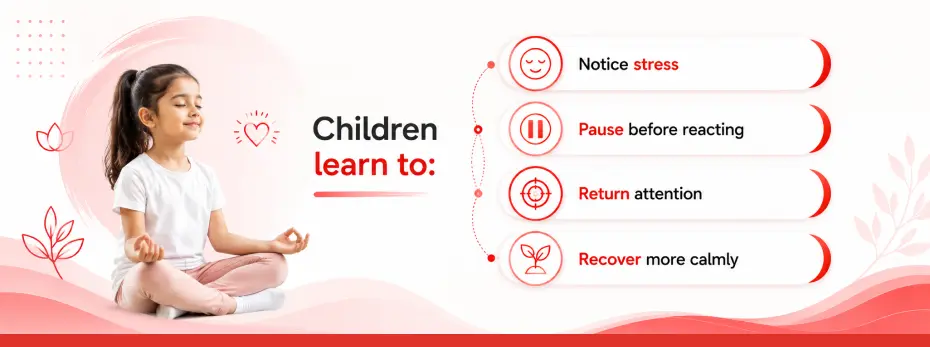
When a child is stressed, whether by an exam, a social conflict, or the background anxiety of an unfamiliar environment, their nervous system activates the sympathetic (‘fight or flight’) response. Heart rate increases, cognitive bandwidth narrows, and the prefrontal cortex, the seat of planning, judgment, and learning, effectively goes offline.
Controlled breathing, a core component of both yoga and mindfulness practice, directly activates the parasympathetic (‘rest and digest’) response, counteracting the stress state and restoring the cognitive capacity needed for learning. This is not metaphorical. It is physiological: deep, slow breathing stimulates the vagus nerve, which reduces cortisol levels and restores heart rate variability. A child who knows how to breathe through anxiety is a child who can think more clearly under pressure.
2. Self-regulation — the skill that makes learning possible
The 2024 Wiley study in Psychology in the Schools describes self-regulation as foundational for maintaining focus, motivation, and perseverance in the face of academic challenges. It distinguishes between behavioural self-regulation, the ability to follow instructions, stay on task, and manage impulses and emotional self-regulation, the ability to manage frustration, anxiety, and disappointment without being overwhelmed by them.
Both forms are developed through yoga and mindfulness practice. A child who practises holding a difficult yoga posture, staying present with discomfort rather than immediately escaping it, is practising exactly the same capacity they need when a maths problem is hard, when a test result is disappointing, or when a friendship is difficult. The mat and the classroom are training the same skill.
3. Attention and executive function — the cognitive benefits
The University of Edinburgh scoping review (2022) found substantial evidence for yoga’s positive effects on executive function, working memory, inhibition, and attention, the cognitive skills that most directly predict academic performance. These are not soft benefits. They are the building blocks of literacy, numeracy, and the ability to learn anything at all.
The mechanism is well understood: mindfulness practice trains the attentional system, the capacity to notice where the mind is and bring it back to where it needs to be. A child who practises this daily through a five-minute breathing exercise or a guided body scan is developing the same attentional muscle they need when a lesson is difficult or when distractions are present.
4. Emotional intelligence — knowing and managing what you feel
The PLOS ONE study from Stanford and Iowa State (2024) found that yoga and mindfulness curricula produced significant improvements in emotion regulation. The Frontiers in Education scoping review found that yoga develops a persistent mindset, the capacity to keep trying when things are difficult through the physical and psychological demands of the practice itself.
For children growing up in Dubai’s multicultural, high-transition environment, where cultural misunderstandings, social reconfigurations, and identity questions are everyday realities, the capacity to understand and navigate their own emotional states is not a luxury. It is a survival skill.
5. Body-mind integration — the physical dimension of wellbeing
Yoga is one of the few school-based interventions that addresses physical, mental, and emotional wellbeing simultaneously. The British Journal of Health Psychology study (2025) found that school yoga programmes improved sleep quality alongside emotional regulation, a finding that is particularly significant for children in high-academic-pressure environments, where poor sleep is both a cause and a symptom of chronic stress.
The physical postures of yoga build body awareness, the ability to notice where tension is being held, what physical state the body is in, and how to shift that state deliberately. Children who develop this awareness carry a self-regulatory tool with them that no medication or counsellor session can replicate because it is entirely internal and always available.
What school yoga and mindfulness is and what it is not
School yoga programmes are not:
- → A religious practice, yoga in school settings is taught as a physical and mental wellness practice, not a spiritual one
- → A replacement for academic rigour, the research shows yoga supports academic performance, not competes with it
- → Only for children who are struggling, the evidence shows benefits across the full range of students, including high performers
School yoga programmes are:
- → A structured, evidence-based intervention for emotional regulation, attention, and stress management
- → Most effective when integrated into the daily timetable, not offered once a week as an elective
- → Age-appropriate and accessible, no prior experience or physical ability required
- → Increasingly recommended by educational psychologists and child development researchers as a mainstream school practice
What Effective Yoga and Mindfulness in Schools Actually Looks Like
- Daily, brief practices embedded into the school day, morning breathing exercises, transition moments between lessons, short body scans before assessments. Five minutes of deliberate practice daily outperforms one hour once a week.
- Teacher modelling — teachers who practise and embody the values of mindfulness in how they respond to children, handle conflict, and manage their own visible stress, produce classrooms where children internalise these practices far more deeply than through instruction alone.
- Age-appropriate progression — younger children need movement-based, playful yoga; older children and adolescents benefit from more reflective, breath-centred mindfulness practices that address the specific pressures they face.
- Integration with academic content — linking mindfulness to exam preparation, to the experience of learning something difficult, and to the social challenges of school life makes it meaningful rather than formulaic.
- A school culture that values it — when a school treats yoga and mindfulness as important enough to timetable, to train teachers in, and to talk about openly, children receive the message that their inner life matters. That message, sustained over years, changes how children relate to themselves.
How Dhruv Global School Dubai Integrates Yogic Values
Yoga is not a programme at Dhruv Global School Dubai. It is a founding value. The Dhruv Group of Schools was established with the explicit philosophy that academic rigour and inner development are not separate goals but the same goal approached from different directions.
The term ‘yogic values’ at Dhruv encompasses more than physical postures. It describes a set of commitments about how people relate to themselves and each other: presence over distraction, effort over outcome, self-awareness over reactivity, compassion over judgment. These values are not declared in a school document and forgotten. They are the operating framework of how teachers interact with students, how the school day is structured, and how children are supported through difficulty.
In practice, this means mindfulness and breathing practices are integrated into the school day, not offered as an add-on for children who are struggling. It means teachers are recruited and trained in part for their capacity for presence and emotional attunement, because a teacher who is themselves grounded and self-aware is the most powerful mindfulness teacher a child can have.
It also means that the school’s approach to academic pressure is not simply to add stress management sessions when exams approach. Across our CBSE curriculum, the emphasis on conceptual understanding over rote memorisation, consistent with both yogic values and the latest CBSE 2026–27 curriculum changes reduces the anxiety that comes from learning that is brittle. A student who understands is more confident under pressure than one who has merely memorised. Understanding is itself a form of inner security.
For families choosing a school in Dubai, the integration of yogic values into Dhruv’s educational philosophy is not a selling point dressed up as culture. It is the reason parents whose children have attended Dhruv campuses in India describe their children as not just academically capable but genuinely resilient, able to handle difficulty, recover from setbacks, and face the unknown with more curiosity than fear. The research explains the mechanism. The school provides the practice.
How Parents Can Support Mindfulness and Emotional Regulation at Home
The research is clear that school-based practices are most effective when they are reinforced at home. Here are a few practical ways parents can support what a school provides without needing any yoga training of their own.
- Normalise talking about the breath. When your child is upset or anxious, try “let’s take three slow breaths together” before trying to solve the problem. This is a concrete, practical regulation tool, not a platitude.
- Model your own self-regulation. Children learn how to manage stress primarily by watching how the adults around them manage theirs. Narrating your own regulation, “I’m feeling frustrated, I need a moment”, teaches self-awareness more directly than any instruction.
- Create space for stillness. In Dubai’s busy family life, deliberate quiet is rare. Ten minutes before bed where screens are off and the room is calm is not nothing, it is the daily reset that sleep research and mindfulness research both identify as essential for children’s mental health.
- Ask about the practice, not just the result. Instead of asking “how did you do?”, after a difficult day or assessment, try “how did you handle it?”, this question values process and self-regulation as much as outcome, which is exactly the message yogic education is trying to build.
Final Thoughts
The case for yoga and mindfulness in schools is no longer built on tradition or intuition alone. It is built on a substantial and growing body of peer-reviewed research showing that these practices measurably improve the outcomes, academic, emotional, and social that parents and schools care most about.
For children growing up in Dubai’s high-achieving, high-transition, multicultural school environment, these practices are not an enrichment extra. They are the foundation of the resilience that makes everything else possible.
A school that takes this seriously that embeds it in daily life rather than offering it on a timetable is a school that understands what children actually need to thrive. Not just academically. As people.