
The flight is booked. The visa is sorted. The boxes are packed. And somewhere between the excitement of a new life in Dubai and the anxiety of the move, a question starts to take up a lot of space in your mind: how will my child handle switching schools?
It is a fair question. For children, school is not just where they learn, it is where they belong. Their friends are there. Their routines are there. Their sense of who they are is built there. Moving from an Indian school to a school in Dubai is not just a change of address. For your child, it can feel like the ground shifting beneath their feet.
The good news is that children are far more adaptable than parents give them credit for. Most children who move to Indian CBSE schools in Dubai settle in within a few weeks, build new friendships, and often thrive in ways they never expected. But ‘settling in’ rarely happens on its own. It happens when parents know what to expect and prepare thoughtfully.
This guide covers the real challenges, academic, social, and emotional that come with the school transition, and exactly what you can do to make it smoother for your child.
First, Understand What Is Actually Changing
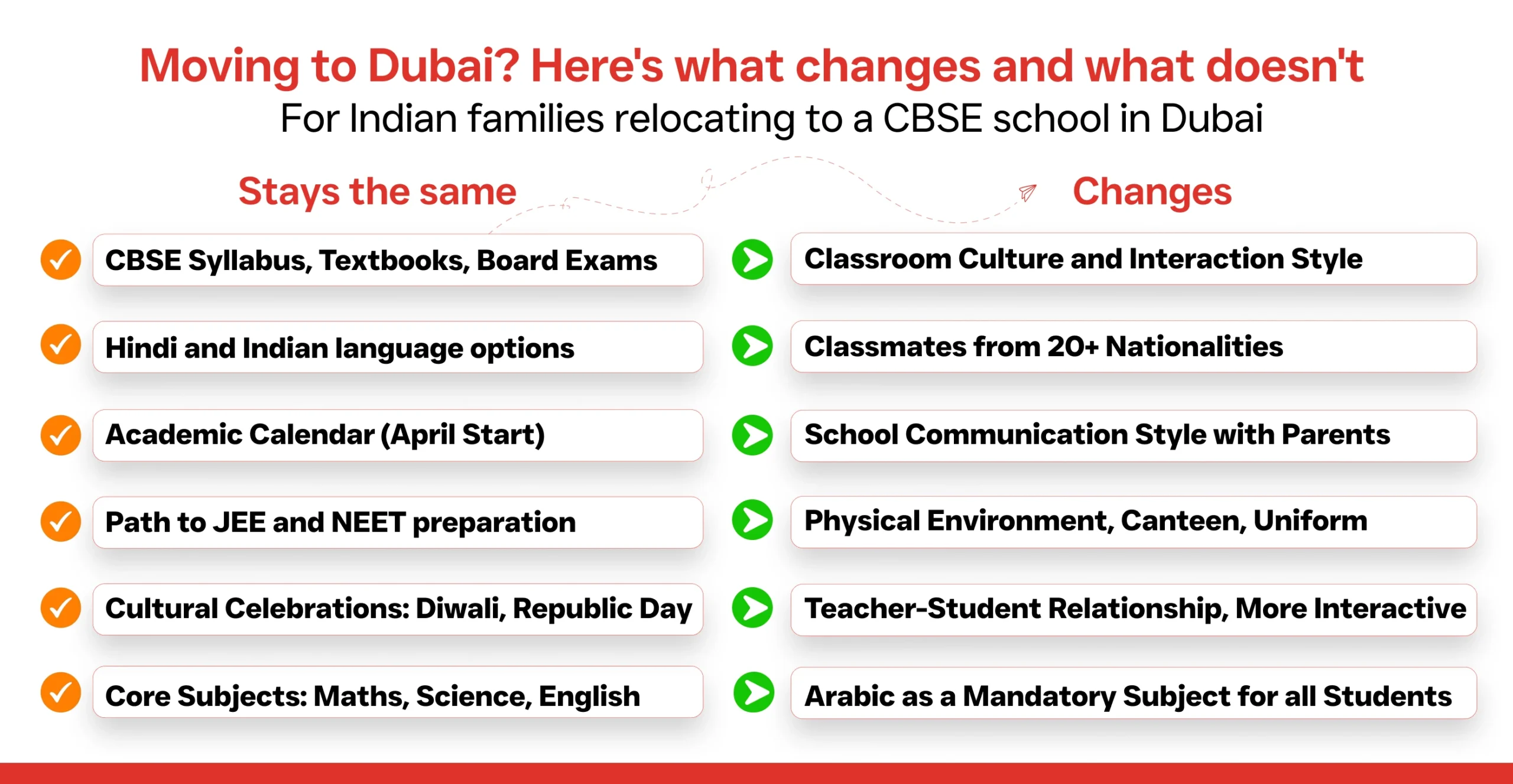
Before you can prepare your child, it helps to understand precisely what is different between a school in India and a school in Dubai, even when both follow the CBSE curriculum.
Many parents assume that because the curriculum is the same, the experience will be the same. It will not. The curriculum is a framework. The experience is everything around it.
The Four Biggest Adjustments Your Child Will Face
1. A classroom with children from many countries
In most Indian schools in India, your child shares a classroom with children who broadly share the same cultural background, language, food habits, and family values. In Dubai, they will sit next to children from the UAE, the Philippines, the UK, Egypt, Pakistan, and dozens of other countries. This is one of the greatest gifts of multicultural education in Dubai but it takes adjustment.
What this means practically: your child may feel like an outsider in the first few weeks. This is completely normal. The friendships will come but they may look different from the tight-knit, same-language friendships your child had in India. Encourage openness. Discourage comparison.
2. A different classroom dynamic
Many Indian schools operate in a relatively teacher-led style: the teacher explains, students listen and take notes, and participation is structured. Dubai’s private schools, even CBSE ones, often have a more interactive, discussion-based approach in the classroom. Students are encouraged to ask questions, share opinions, and work in groups more frequently.
For some children, this feels liberating. For quieter or more introverted children who are used to listening rather than speaking up, it can feel uncomfortable at first. They may worry they are expected to perform rather than learn.
Help your child understand this shift before they arrive. Tell them: in your new school, asking a question is not a sign of not knowing something. It is a sign of thinking. Classroom participation in Dubai schools is expected, and it is something they will grow into.
3. The social pressure of being new
Psychologists who work with expat families have identified what is sometimes called expat child syndrome, the emotional and psychological strain that children feel when adjusting to a new country and school. It does not affect every child, but the signs are worth knowing: withdrawal, irritability, unexplained physical complaints like headaches or stomach aches, reluctance to go to school, and difficulty sleeping.
These are not signs that something is seriously wrong. They are signs that your child is working hard to process a major life change. The key is to catch them early, name them calmly, and not minimise them.
What helps most, according to the research: emotional support from parents that is consistent and calm. Just presence, curiosity, and the clear message: I see this is hard, and I am here.
4. The curriculum may be the same, but the pace can feel different
Because Dubai schools attract children from across India and because CBSE schools here often draw students who are academically motivated, your child may find that the academic pace at Dubai CBSE schools feels slightly faster or more competitive than what they experienced in India. This is especially common in Maths and Science.
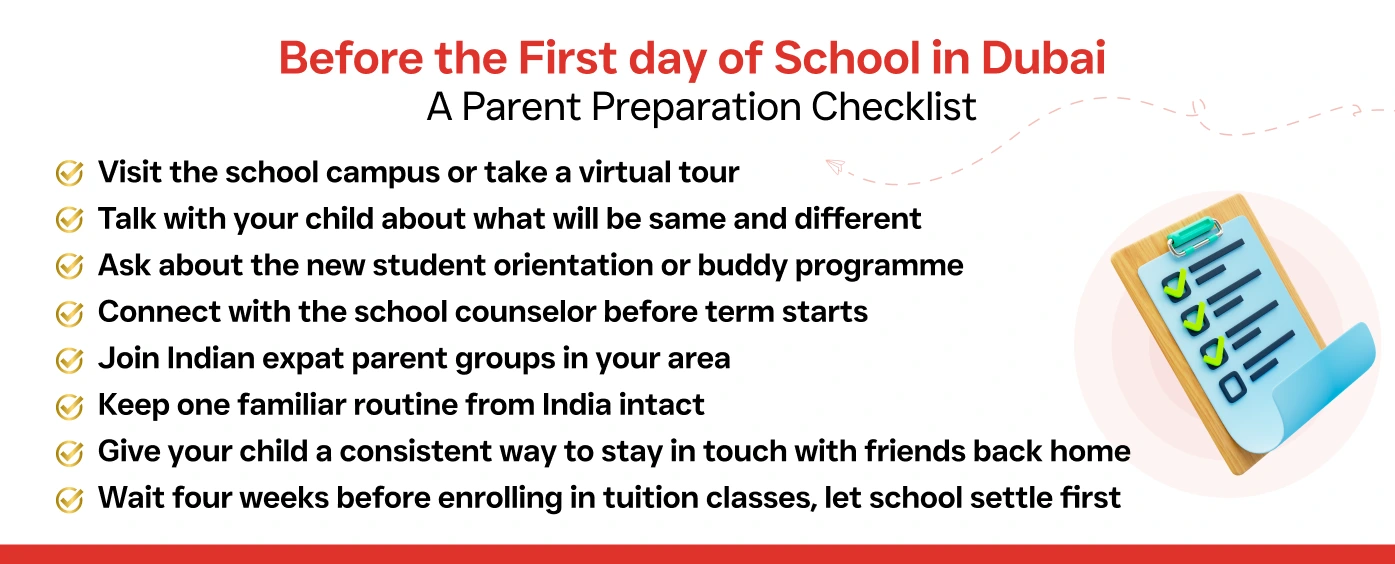
This is not a reason to panic. But it is a reason to spend the first month or two simply observing where your child is academically without immediately enrolling them in five tuition classes. Give the new school a chance to assess your child and communicate with you. Most good schools in Dubai will do exactly this.
How to Prepare Your Child Before the Move
Talk about it honestly not just positively
Parents often focus on selling the excitement of Dubai to their children: the tall buildings, the beaches, the malls. These things are real, and they matter. But your child also needs to know that it is okay to miss home, making new friends takes time. That feeling nervous on the first day is completely normal.
Children who are given honest, balanced information about a transition are less likely to feel blindsided when the hard parts arrive. And the hard parts will arrive. Being prepared for them is what allows children to move through them.
Research the school together
Arrive before school starts if possible
If your schedule allows, try to arrive in Dubai at least two to three weeks before the new school term begins. This gives your child time to settle into the new home, explore the neighbourhood, visit the school campus if the school offers pre-term visits, and simply adjust to the time zone and climate before adding the pressure of the first school day.
Keep a connection to India alive
One of the most consistent findings in research on expat children and cultural identity is that children who maintain strong connections to their home culture adjust better not worse to their new environment. Staying in touch with grandparents and old friends, celebrating Indian festivals, cooking familiar food at home, continuing with Indian classical music or dance if your child already does it, all of these anchor a child’s sense of self during a period of significant change.
Give the adjustment a realistic timeline
Most child development experts suggest allowing at least six to eight weeks before making any judgements about how a child is settling in. The first two weeks are almost always hard. Weeks three and four often see small but meaningful improvements. By weeks six to eight, most children have found their footing, at least socially.
Resist the urge to interpret the first two weeks as a sign of how things will be permanently. They almost never are.
Practical Things to Sort Out Before the School Year Starts
Documents you will need for school admission in Dubai
- Passport copies for the child and both parents
- UAE residence visa (the child’s visa must be in order before admission is confirmed)
- Previous school records, report cards, and transfer certificate
- Vaccination records — Dubai schools require an up-to-date immunisation history
- Passport-size photographs
- Emirates ID (once processed)
Understanding KHDA ratings
Academic calendar and the April vs September question
CBSE schools in Dubai follow an April start, which aligns with the Indian academic year. This means if you are arriving mid-year, in October, your child is stepping into a school year that is already six months in. Ask the school directly: what is their process for mid-year admissions? Do they offer any bridging support? A school with strong pastoral care will have a clear answer.
Arabic as a mandatory subject
How Dhruv Global School Dubai Supports New Students
At Dhruv Global School Dubai, we understand that choosing a school in a new country is one of the most significant decisions an expat family makes. And we know that the first few weeks in a new school can feel daunting for children and parents alike.
Every new student at Dhruv Global School Dubai goes through a structured orientation process. Peer buddy systems pair incoming students with existing students who help them find their feet in the first few weeks. Our counselors are available to both students and parents throughout the transition period not just on the first day.
The school’s yogic values framework built around calm, self-awareness, and community creates a school culture where children feel safe to be themselves, even when they are still finding out who ‘themselves’ is in this new environment.
We also maintain the CBSE curriculum with full continuity, so if you are planning to return to India in the future, your child’s CBSE education in Dubai will translate seamlessly for board exams, for college admissions, and for JEE and NEET preparation.
Parents of new students tell us the same thing, again and again: they expected settling in to take months. It took weeks. The community did that.
Final Thoughts
Moving a child from one school to another, especially across countries is not a small thing. It takes courage from the child and patience from the parent. The transition will have hard days. There will be evenings when your child says they want to go back. There will be mornings when getting them into the car feels like a battle.
But there will also be the day usually somewhere around week five or six when your child comes home and tells you something funny that happened at school. When they mention a new friend’s name. When they say, without quite realising it, ‘I like it here.’
That day comes for almost every child. Your job, as a parent, is to make sure they have the support to get there.