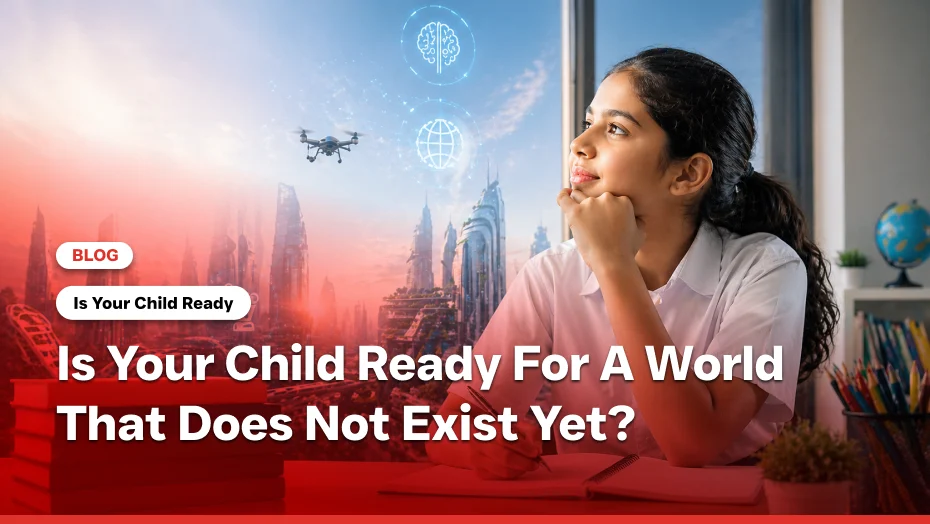
Think about the job you do today. The tools you use. The skills that make you valuable. Now ask yourself honestly: how many of those things existed when you were sitting in a school classroom?
For most working adults, the answer is: very few. The internet, smartphones, cloud computing, social media, remote collaboration, data analytics, none of these featured in the school curricula that produced today’s workforce. Yet somehow, adaptable people found ways to learn, pivot, and contribute. Now consider what your child will face.
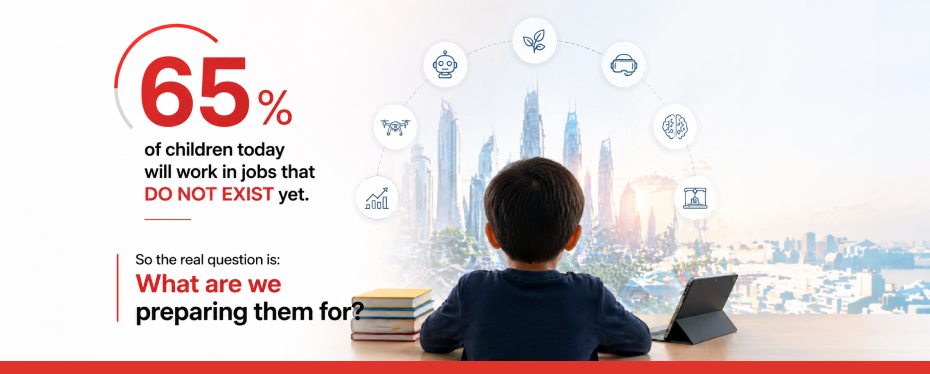
The World Economic Forum’s Future of Jobs Report 2025 makes a striking projection: 65% of children entering primary school today will work in job categories that do not yet exist. This is not speculation. It is the considered estimate of the world’s leading forum on economic and employment trends, drawing on data from hundreds of employers across industries and geographies.
If this is true and there is substantial reason to believe it is, then the question every parent in Dubai must sit with is a deeply uncomfortable one: if we cannot know what jobs our children will do, what exactly are we preparing them for? And is the education they are receiving today doing that?
How AI and Automation Are Redefining the Future of Work
Every generation has faced technological change. The argument that ‘this time is different’ has been made before and sometimes has been wrong. But the evidence from 2025 suggests that the scale, speed, and breadth of current disruption genuinely is different from previous waves.
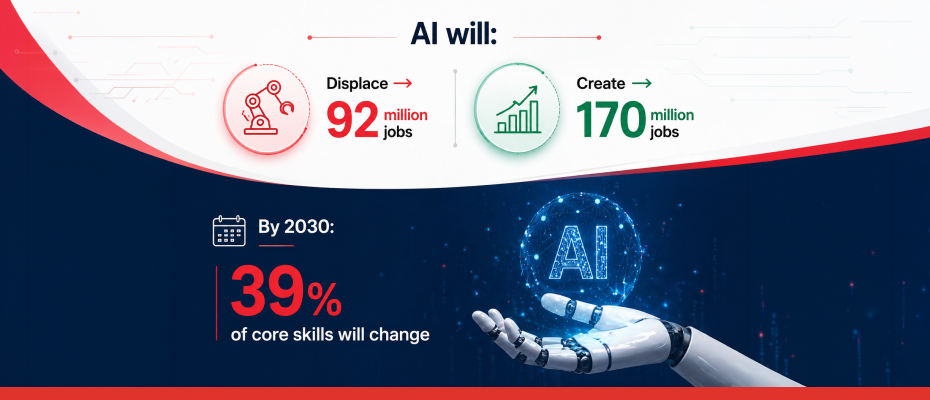
According to the WEF Future of Jobs Report 2025, AI will displace 92 million jobs globally in the coming years. The same report estimates it will create 170 million new ones. The net number sounds positive. The challenge is that the displaced jobs and the created jobs are not the same jobs, or the same skills, or the same people and the transition between them will be rapid, uneven, and demanding.
Employers globally now expect that 39% of key skills required in the job market will change by 2030, just four years away. The top rising skills are AI and big data literacy, creative thinking, resilience and adaptability, and curiosity and lifelong learning. Notably, none of these is primarily a technical skill. They are human skills, the capacities that AI cannot replicate.
For families based in Dubai, the context is even more acute. The UAE’s job market is already changing faster than most. Roles in AI, sustainability, health technology, cybersecurity, and cross-cultural business leadership are growing rapidly. Traditional roles in administration, basic data processing, and routine customer service are shrinking. The gap between what education is producing and what the economy needs is a stated concern of the UAE government itself; nearly 40% of UAE companies report difficulty finding skilled talent for technical and specialised roles.
What Schools Teach vs What the Future Requires
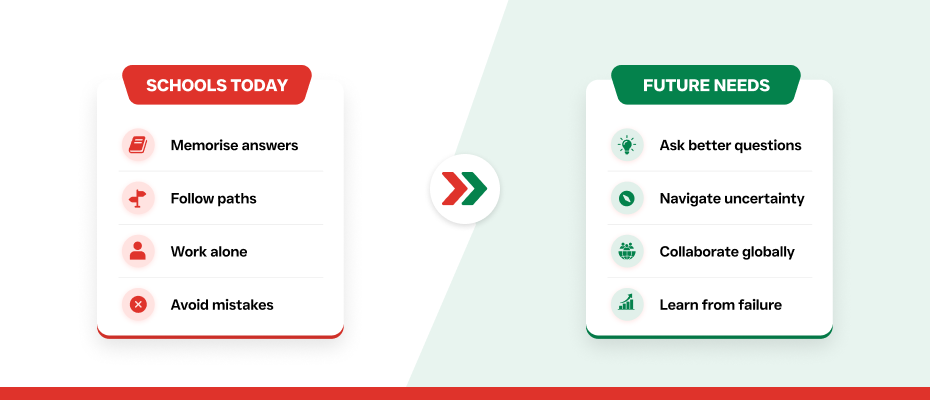
This is not an argument against academic rigour. Mathematics, science, language, and analytical thinking remain foundational, the WEF report consistently shows that these remain in demand. The shift is in how those subjects are taught: whether they develop thinking or simply reward memorisation; whether they build adaptability or condition compliance.
The UAE Is Already Responding And What It Means for Your Child
The UAE government has read the same reports. It has reached the same conclusions. And it is acting on them with the speed and decisiveness that characterises policy in this country.
In 2025, the UAE became one of the first countries in the world to introduce Artificial Intelligence as a compulsory subject from kindergarten through Grade 12. Not as a coding class. Not as an elective. As a core, assessed, mandatory subject for every student in the country. The Zayed Education Foundation, also launched in 2025, aims to support 100,000 young talents by 2035, specifically preparing them for leadership in science, the economy, and sustainability.
The KHDA’s Education 33 strategy sets an explicit national goal: to position Dubai as a global education hub with universities ranked in the world’s top 100, and a school system aligned not with what the economy needed in 2010, but with what it will need in 2033 and beyond. The government’s “We the UAE 2031” roadmap explicitly links educational outcomes to the country’s future economic and social goals.
The UAE is not passively hoping that schools will adapt. It is actively restructuring its education system around the demands of the future. The question for each family is whether the specific school they choose is genuinely aligned with that direction or whether it is a school that has updated its brochure but not its classrooms.
What "future-ready" actually means and what it does not
- Future-ready does NOT mean: teaching children to code, exposing them to the latest apps, or loading the timetable with STEM subjects.
- Future-ready DOES mean: building the capacities that make a person adaptable regardless of what specific technologies emerge.
- The WEF's top rising skills for 2030 are: creative thinking, resilience and adaptability, curiosity and lifelong learning, leadership, and analytical thinking. These are developed through how a school teaches, not just what it teaches.
- A child who has learned to think critically, persist through difficulty, collaborate across differences, and approach new problems without fear is future-ready. A child who has simply memorised a larger volume of content is not.
4 Most Important Skills for the Future Workforce
Research from the OECD, the WEF, and multiple education institutions converges on a broadly similar set of capacities that will define success in the future economy. These are not new, educators have discussed them for decades. What is new is the urgency, and the specificity of the evidence now linking them to real-world outcomes.
1. Critical thinking — the ability to question, not just absorb
In a world where AI can retrieve any fact in seconds, the ability to remember facts is increasingly less valuable. What AI cannot do well, yet, is question the relevance of those facts, challenge the assumptions behind them, and construct genuinely original arguments. The ability to question answers is the new superpower, as one education research group put it. Schools that develop this through discussion, debate, Socratic questioning, and project-based inquiry are building children for the future. Schools that reward accurate recall alone are building children for an economy that is already shrinking.
2. Creativity — connecting ideas across domains
Creativity is not about artistic talent. It is about the cognitive capacity to connect disparate ideas to see a problem from an angle others have not considered, to combine knowledge from different fields into something new. This is precisely what the WEF identifies as a top rising skill, and precisely what standardised testing does not measure or reward. Art, music, drama, design, and interdisciplinary project work are not enrichment extras, they are the primary environments in which creative thinking is trained.
3. Adaptability — tolerating and navigating uncertainty
4. Cross-cultural intelligence — collaborating with people who are different
How Parents Can Prepare Children for the Future
Ask 'why' and 'what do you think' more than 'what did you learn today'
Let them fail, and then help them analyse the failure
Expose them to people, problems, and perspectives beyond their immediate world
Dubai makes this unusually easy. Use it. Encourage friendships across cultural lines. Travel when possible. Discuss global issues at dinner. Ask your child how things might look from another person’s perspective. These habits of mind compound over years into the cross-cultural intelligence that defines genuinely global citizens.
Value effort and process over results
Children who are praised primarily for outcomes for the grade, the rank, the result, develop a fixed mindset that makes adaptability harder. Children who are praised for the quality of their effort, their persistence, and their willingness to try difficult things develop the growth mindset that makes lifelong learning possible. The psychologist Carol Dweck’s research on this is among the most replicated in modern educational psychology.
Future-Ready Education in Dubai: What to Look For
- “How is critical thinking taught and assessed — can you give me a specific example from a recent lesson?”
- “What does project-based or inquiry learning look like at this school — what proportion of learning happens this way?”
- “How does the school respond when a student fails — what is the process and the philosophy?”
- “How do students here build genuine cross-cultural relationships, not just co-exist in the same classroom?”
- “How does the school build curiosity and love of learning?”
- “Can you describe a time the school changed its approach because research or evidence suggested something better?”
A school that has genuinely thought about these questions will answer them specifically and confidently. A school that has not will give you polished but vague responses about holistic education and 21st-century skills. The difference is audible.
How Dhruv Global School Dubai Prepares Students for the Future
At Dhruv Global School Dubai, future-readiness is not a programme. It is the lens through which we think about every decision about curriculum, about how we teach, about what we celebrate, and about the kind of adults we are trying to help our students become.
Our CBSE curriculum gives students the rigorous academic foundation that Indian and global universities require. But rigour alone does not produce future-readiness — and we have never believed it does. Alongside academic rigour, our students develop through sport, music, art, collaborative projects, and exposure to multiple ways of thinking about the same problem.
The multicultural environment of our school is not a background fact. It is a teaching resource. A student who learns to navigate genuine disagreement with a peer from a different cultural background, to understand their perspective without abandoning their own, and to collaborate productively across that difference is developing capacities that no curriculum can fully teach but that experience, well-designed, can build.
Our teachers are selected in part for their curiosity for the quality of vision, passion, and genuine love of learning they bring to the classroom. Research consistently shows that teachers who model intellectual curiosity and delight in difficulty produce students who develop the same habits. This is not something you can mandate in a syllabus. It is something you recruit and cultivate.
We live in Dubai, a city that did not exist in its current form 40 years ago and will look completely different in another 40. The ambition that built this city, and the adaptability it demands, are not separate from what we try to build in our students. Dubai itself is the most compelling argument for why future-readiness is not optional. The children who will thrive here, and wherever they go next, are the ones who can think, adapt, lead, and learn. We build those children.
Final Thoughts
You cannot prepare your child for a world that does not exist yet by optimising them for the world that already does. The skills, the habits, the capacities that will matter in 2035 and 2040 are not a mystery, the research points to them clearly. What remains is the will to choose schools and environments that genuinely develop them, and to model them at home.
The most future-ready thing you can give your child is not a particular subject, or a particular school, or a particular qualification. It is the confidence to engage with what they do not know, to be curious rather than anxious in the face of the unfamiliar. That is the one skill that will never be automated away.