Dubai’s education system has never stood still. But the pace of change in 2026–27 is different in kind, not just in degree.
The Knowledge and Human Development Authority confirmed that 10 new schools opened in Dubai alone in the 2024–25 academic year, adding over 16,000 seats and contributing to a 6% rise in private school enrolment, now totalling more than 387,000 students across 227 private schools. As part of the Education 33 strategy announced in October 2024, the KHDA has committed to delivering 49,900 new school seats and at least 100 new private schools in Dubai and Abu Dhabi by 2033.
Numbers tell part of the story. The more interesting part is what is driving the change and what it signals about where education in this city is headed.
For parents navigating school choices in Dubai, understanding these trends is not optional. The school that looked like the right choice three years ago may be falling behind a market that is moving fast. And the trends shaping Dubai’s classrooms today will shape your child’s readiness for the world they graduate into.
Here is what is actually happening.
Trend 1: AI Is Moving from Buzzword to Curriculum
Every school in Dubai has been talking about artificial intelligence for several years. In 2026–27, the gap between schools that are genuinely integrating it and schools that are performing it has become visible.
New school openings in Dubai Sports City in 2025 are featuring AI-focused curricula, innovation labs, and facilities built from the ground up around technology-integrated learning. These are not retrofitted computer labs. They are learning environments designed from the first brick around the assumption that computational thinking, data literacy, and human-AI collaboration are core educational requirements, not extracurricular add-ons.
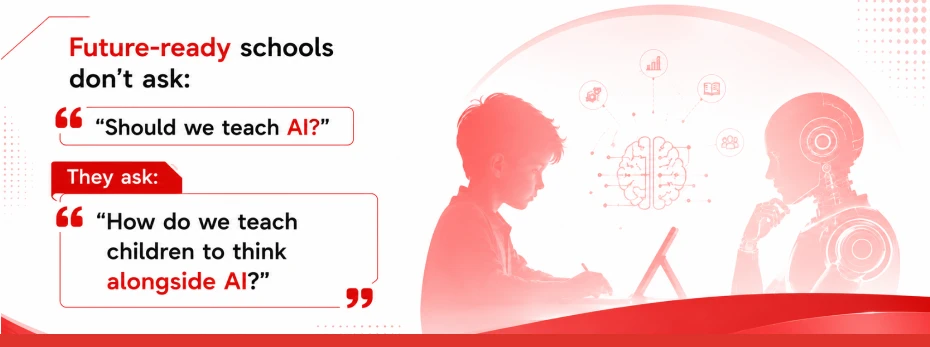
The UAE’s national ambition is the context. The country’s AI 2031 strategy and its positioning as a global hub for artificial intelligence investment are creating demand for an education system that produces graduates who are not simply consumers of AI tools but literate, critical, and creative participants in an AI-driven world.
What this means practically for parents: the question to ask is not whether a school has iPads or a coding club. It is whether computational thinking is embedded in how the school teaches mathematics, science, and problem-solving, across every subject, every year. That integration is the differentiator.
Trend 2: Wellbeing Is Now a Measurable Priority
Student wellbeing has been part of the Dubai education conversation for years. What is new in 2026–27 is the rigour with which it is being taken seriously, not as a pastoral programme running alongside education, but as a core component of what good schooling means.
The UAE has designated 2026 as the Year of the Family, explicitly linked to the National Family Growth Agenda 2031 and aimed at strengthening cohesive family ties for citizens and residents. In schools, this is manifesting as a genuine rethinking of what the school environment does to children’s mental and emotional health, not just their academic performance.
New schools are incorporating neuroarchitectural design, values-based leadership programmes, and deliberate wellbeing frameworks into their school design from the outset. Neuroarchitecture, the design of physical spaces based on how they affect brain function and emotional regulation, represents a shift from treating wellbeing as a programme to treating it as an environment.
For existing schools, the trend is showing up in how they talk about and measure student experience. KHDA inspections have long included wellbeing as a rated category. The pressure to perform on that dimension is intensifying as parents become more informed about the relationship between emotional safety and academic achievement.
Trend 3: The Digital Safety Conversation Has Become Law
Dubai parents have been worried about screen time, social media, and online risk for years. In 2026–27, that worry has a legal framework behind it.
A new Federal Decree-Law on Child Digital Safety, published in December 2025, establishes a framework to protect children from online risks, applying to platforms and internet service providers operating in the UAE or targeting UAE users. It introduces expectations for default privacy, age verification mechanisms, filtering, age-ratings, and controls on targeted advertising.
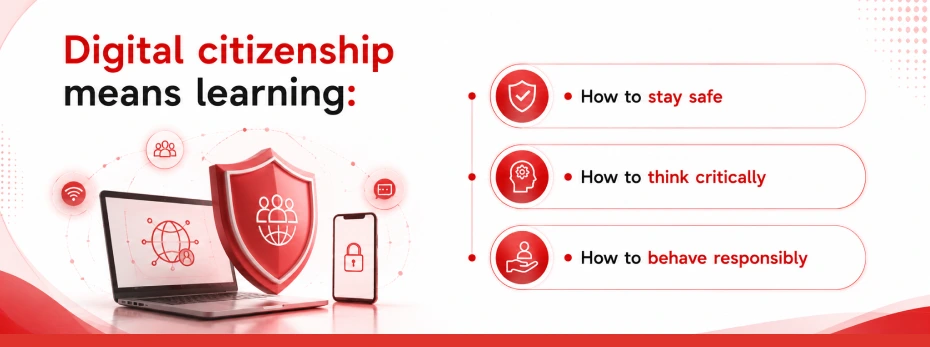
For schools, this means the conversation about digital citizenship, how children understand, navigate, and protect themselves online has moved from optional enrichment to explicit responsibility. Schools that are teaching media literacy, online safety, and the critical evaluation of digital content are no longer going above and beyond. They are meeting the direction of travel of national policy.
For parents, this trend is a prompt to ask their child’s school a direct question: how are you preparing our children to navigate the digital world thoughtfully, not just safely, but with genuine critical intelligence about what they encounter there?
Trend 4: The Curriculum Choice Landscape Is Expanding
Dubai has always offered more curriculum variety than almost any city on earth. In 2026–27, that variety is expanding further and the quality across the spectrum is rising.
British, American, Indian, and IB schools dominate demand, as expatriate parents prioritise globally recognised instruction and language fluency. But the patterns within those broad categories are shifting.
New school openings include five UK curriculum institutions, alongside IB and American curriculum options, with fee ranges spanning from accessible mid-range to ultra-premium. The significant development is not just the volume of new schools but the deliberate spread across price points, reflecting the KHDA’s explicit goal of making quality education more accessible.
Sixteen new early childhood centres are opening, following curriculum options ranging from the UK Early Years Foundation Stage and the Creative Curriculum to Montessori and Maple Bear. The diversity of early years provision in particular is expanding in ways that give families more genuine choice, if they know how to evaluate it.
For families making curriculum decisions, the expanding landscape is empowering and daunting simultaneously. The British curriculum remains dominant. The UAE education market growth is driven by a growing population, increasing expatriate families, and widespread awareness of early childhood education with British curriculum schooling leading in demand. Within that dominant category, however, the range of quality and approach is considerable.
Trend 5: Arabic Language Learning Is Now an Early Years Requirement
Trend 5: Arabic Language Learning Is Now an Early Years Requirement it.
The KHDA’s policy push now mandates Arabic language learning in Dubai private schools and early childhood centres from birth to six, a major shift in what “early years” means, especially for families in UK, US, and IB settings. This is not just an additional lesson, it is a direction of travel: early years is being treated as foundational, structured, and culturally rooted.
For many expatriate families, this is a welcome development. Arabic language proficiency is a genuine asset in the UAE, professionally, socially, and culturally and early childhood is the optimal window for language acquisition. For families who had not anticipated this element of their child’s early years education, it is worth understanding how their school is implementing it.
The broader signal of this policy is important. Dubai is not building an education system that is merely internationally oriented. It is building one that is internationally competitive and culturally grounded simultaneously. Schools that navigate that balance thoughtfully are the ones that serve families in this city most completely.
Trend 6: The School Day and Calendar Are Being Standardised
Several practical changes to how the school year and school day operate in Dubai are relevant to every family in the 2026–27 year.
The Ministry of Education introduced a unified school calendar for the 2025–26 academic year, applying to both private and public schools nationwide, supporting consistency, shared breaks, and a stronger sense of community, introduced in line with the 2025 UAE theme of the Year of Community.
From January 2026, private schools in Dubai finish classes at 11:30 AM on Fridays, aligning school schedules with revised Friday prayer timings across the UAE. The practical implications for families, earlier pickups, adjusted transport routes, after-school activities shifting to other days are worth planning for.
Final assessments must be completed in the last week of each term, and students are expected to attend school until the final day, except those sitting international exams. Attendance enforcement is being taken more seriously across the Dubai school system, reflecting a growing evidence base on the relationship between consistent attendance and educational outcomes.
What This Means for Families Choosing a Dubai School
The trends above are not abstract. They translate directly into the questions worth asking at every open day and admission meeting.
Does the school have a genuine, integrated approach to computational thinking or a dedicated technology lesson that sits apart from everything else?
How does the school define and measure student wellbeing and what does support look like in practice for a child who is struggling?
How is the school approaching digital citizenship and online safety, as a one-off workshop or as an ongoing, developmental curriculum?
How are they implementing the Arabic language requirement in the early years and what does that look like for a family with no Arabic at home?
What are the university pathways their students access and how actively does the school support that process?
These are not hostile questions. They are exactly the questions that a confident, excellent school welcomes. Because a school with genuine answers to all of them is a school that has been thinking carefully about the world its students are growing into.
Final Thoughts
Dubai’s education landscape is changing faster than ever before. Artificial intelligence, student wellbeing, digital citizenship, multilingual learning, and future-focused curricula are no longer emerging ideas, they are becoming the new standard.
For parents, this means choosing a school can no longer be about rankings, facilities, or curriculum alone. It is about finding a learning environment that is preparing children for a world that is evolving far beyond the classroom.
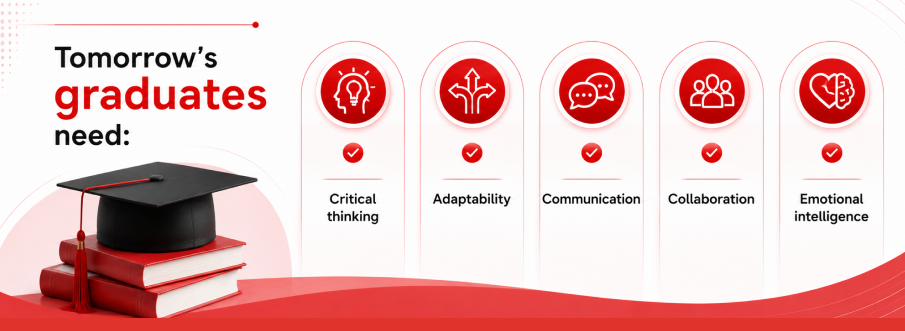
The best schools are those that combine strong academic foundations with the skills that will matter for decades to come: critical thinking, creativity, collaboration, emotional intelligence, adaptability, and the confidence to keep learning throughout life. These are the qualities that technology cannot replace and the ones that will help children thrive regardless of how industries, careers, or society change.