

It is the question that sits at the centre of almost every Indian family’s school search in Dubai.
You have shortlisted schools. Some follow CBSE, the curriculum your child may already be on, the one you understand, the one that connects to the Indian system you grew up in. Others follow Cambridge IGCSE, the curriculum that dominates Dubai’s premium school market, the one that opens international university doors, the one that several other families in your building have chosen.
Both have genuine advocates. Both have genuine critics. And the advice circulating in WhatsApp parent groups is confident, contradictory, and almost entirely based on individual experience rather than a clear-eyed understanding of what each curriculum actually does.
This blog is the clear-eyed version. Not a verdict, because there is no single right answer. But an honest, specific comparison that gives you what you actually need to make the decision well.
What Each Curriculum Is Built For
Before comparing content, structure, or career outcomes, it helps to understand what each curriculum was designed to achieve, because the design philosophy shapes everything else.
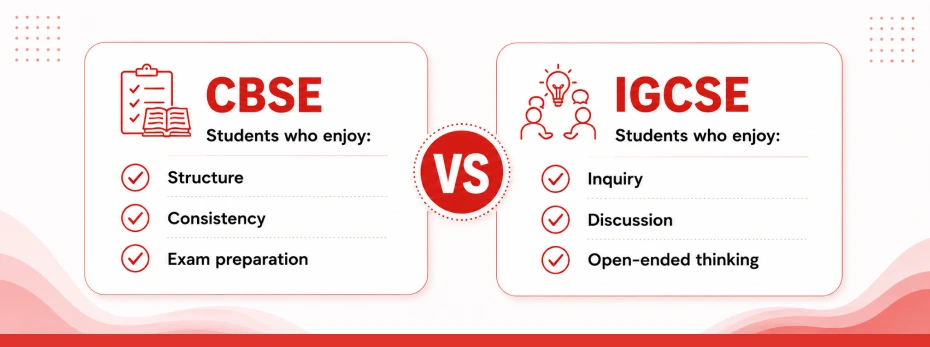
CBSE — the Central Board of Secondary Education is India’s national curriculum board. It was designed to provide a standardised, nationwide educational framework for Indian students, with clear alignment to India’s national competitive examinations, JEE for engineering, NEET for medicine, and various state-level entrance tests. Its content is built around the NCERT textbook framework. Its assessment is primarily examination-based. Its strengths are breadth of content coverage, rigorous mathematical and scientific foundations, and direct preparation for India’s competitive exam landscape.
Cambridge IGCSE — the International General Certificate of Secondary Education, developed by Cambridge Assessment International Education was designed to serve internationally mobile students across 160 countries. It was built around the development of critical thinking, independent enquiry, and the ability to apply knowledge across contexts. Its content is assessed through a combination of written examinations, coursework, oral assessments, and practical components. Its strengths are analytical depth, global university recognition, and the development of transferable cognitive skills.
Neither is a superior system in absolute terms. They are different systems optimised for different destinations and understanding which destination your family is headed toward is the most useful starting point for this decision.
The Content Difference — What Children Actually Learn
In Mathematics, CBSE covers a broader range of topics across the secondary years — Arithmetic Progressions, Coordinate Geometry, Probability, Trigonometry, and Statistics all feature prominently in Grades 9 and 10. The emphasis is on content mastery and procedural accuracy. Cambridge IGCSE Mathematics covers a comparable range but places a heavier emphasis on problem-solving, mathematical reasoning, and the application of concepts to novel situations. A CBSE student who scores well has demonstrated content knowledge. A Cambridge IGCSE student who scores well has demonstrated both content knowledge and mathematical thinking.
In Sciences, CBSE follows a tightly defined NCERT-aligned syllabus across Physics, Chemistry, and Biology, content that maps directly to JEE and NEET syllabi. Cambridge IGCSE Sciences can be taken as separate subjects or as Combined Science, with a strong emphasis on practical investigation and scientific reasoning alongside content. The content overlap is significant, probably 70 to 80 percent, but the framing is different. CBSE asks students to know science. Cambridge IGCSE asks students to do it.
In Languages, CBSE requires English and Hindi as core languages, with regional language options. Cambridge IGCSE offers over 30 language options and assesses English through reading, writing, and listening components that reward genuine communicative competence rather than examination technique. For Indian students whose first language is not English, the Cambridge approach to language development is frequently reported as more genuinely developmental, though it also demands more.
In Humanities, CBSE’s Social Science curriculum covers History, Geography, Political Science, and Economics in an integrated framework tied to India’s national narrative and constitutional values. Cambridge IGCSE Humanities subjects, History, Geography, Economics, Business Studies, are taught and assessed as separate disciplines, with greater emphasis on analytical writing, source evaluation, and the construction of arguments from evidence.
The Assessment Difference — How Children Are Evaluated
This is where the two systems diverge most visibly and where the implications for how children experience school are most significant.
CBSE assessment is primarily examination-based. Internal assessment accounts for 20% of the final Grade 10 mark, with the remaining 80% determined by the Board examination at the end of Grade 10. The examination format rewards content recall, structured response, and speed of application across a defined syllabus.
Cambridge IGCSE assessment varies by subject but typically includes written examinations, coursework components, practical assessments, and oral tests in language subjects. The final grade reflects performance across all these components, which means a student’s demonstrated capability across the full range of a subject contributes to their result, not just their performance on a single day.
The practical implication of this difference is significant. A child who understands a concept deeply but performs poorly under timed examination conditions, a child who is a strong thinker but an anxious test-taker, is more likely to be accurately assessed by the Cambridge system than the CBSE one. Conversely, a child who is disciplined, methodical, and works well under examination conditions may find the CBSE assessment format more aligned with their strengths.
Neither approach to assessment is inherently superior. They are measuring different dimensions of capability and a child’s results under each system may look quite different for reasons that have nothing to do with their actual understanding.
The Grading Difference, What Results Actually Mean
CBSE grades on a percentage basis, a raw score out of 100, typically presented as a percentage alongside a grade point. The Grade 10 board result is widely understood by Indian universities and used directly in admission calculations.
Cambridge IGCSE grades from A* to G, with U for ungraded. The A* represents exceptional mastery, the highest possible grade and carries significant weight in international university admissions. The grade distribution across the full A* to G range gives universities a nuanced picture of where a student sits within the candidate population globally.
For Indian parents comparing the two systems, the grading difference can feel disorienting at first. A child who is accustomed to receiving 85 or 90 percent in CBSE assessments may receive a B or a C in their first Cambridge IGCSE examinations, not because they are performing worse, but because the systems are measuring and representing performance in fundamentally different ways.
This matters for managing expectations during the transition, both the family’s expectations and the child’s own sense of their capability.
The University Pathway Difference, Where Each Leads
This is the dimension that matters most for families making long-term plans and the one that most clearly determines which curriculum is right for a specific child.
If your family is planning to return to India for higher education
CBSE is the more straightforward choice. CBSE Grade 10 and Grade 12 results are directly applicable to Indian university admissions. More critically, if JEE or NEET is in view and for many Indian families in Dubai, it is, CBSE’s alignment with the NCERT syllabus that underpins those examinations is a genuine practical advantage. Cambridge IGCSE students can and do crack JEE and NEET, but they require additional targeted preparation to align with the specific content and format of those examinations. That preparation is manageable, but it is an additional layer.
If your family's plans include international university destinations
UK, USA, Canada, Australia, Singapore, UAE universities, Cambridge IGCSE and A Levels are the more direct pathway. Cambridge qualifications are explicitly recognised by universities across all of these destinations. The British curriculum is accepted at universities worldwide, making it ideal for families who may relocate in the future. CBSE qualifications are recognised by Indian universities and by some international institutions, but they require additional translation, either through conversion processes or supplementary qualifications, for many international admissions contexts.
If your family's plans are genuinely uncertain
You do not know whether you will return to India, move to another country, or stay in Dubai, Cambridge IGCSE is the more flexible choice. Its international portability means that wherever you end up, your child’s qualification is understood and valued. CBSE’s portability outside the Indian educational system is more limited.
The Transition Question, What Happens If You Switch
Many Indian families in Dubai start their children on CBSE, often because that is the curriculum they know and trust and then consider switching to Cambridge IGCSE in the middle school years.
This is a common pattern, and it is worth being honest about what it involves.
A student moving from CBSE to Cambridge IGCSE in Grade 6 or 7 typically adjusts well. The content overlap at this level is sufficient, and the child has enough time before the IGCSE examinations to internalise the different approach to assessment and thinking that Cambridge demands. The adjustment period is real, the first term in a Cambridge school often involves recalibration, but it is very manageable at this age.
A student switching in Grade 8 or 9 has less runway. The IGCSE examination years begin in Grade 9, which means a student who joins a Cambridge school at this stage is simultaneously learning the content, adjusting to the assessment format, and sitting examinations within twelve to twenty-four months. This is not impossible, and many students do it successfully, but it requires significant support from the school and significant commitment from the student.
Switching after Grade 9, particularly mid-IGCSE is genuinely difficult and generally not advisable unless circumstances leave no alternative. Curriculum disruption in examination years carries real academic risk.
The practical implication: if IGCSE is likely to be your destination, making the move by the end of Grade 7 gives your child the best possible transition experience.
The Cultural and Social Dimension
This one is rarely discussed in the CBSE vs IGCSE conversation and deserves to be.
CBSE schools in Dubai serve a predominantly Indian student population. The cultural environment, the references, the social dynamics, the shared understanding of India’s educational system and its stakes is familiar and comfortable for many Indian families, particularly those who are newer to Dubai or who maintain strong ties to life in India.
Cambridge IGCSE schools in Dubai are typically more internationally diverse — British, American, European, Australian, and Indian families alongside many others. For some Indian families, this diversity is exactly what they want: an environment that prepares their child for genuinely international contexts, that exposes them to different perspectives and social norms, and that builds the cross-cultural competence that the international professional world demands.
For others, the cultural familiarity of a predominantly Indian school environment is a genuine comfort, particularly in the early years of a Dubai relocation, when everything else is already new.
Neither environment is better. But the social experience your child has at school is not separate from their education. It is part of it. And it is worth thinking about explicitly rather than leaving it as an afterthought to the curriculum comparison.
The Honest Decision Framework
Choose CBSE if:
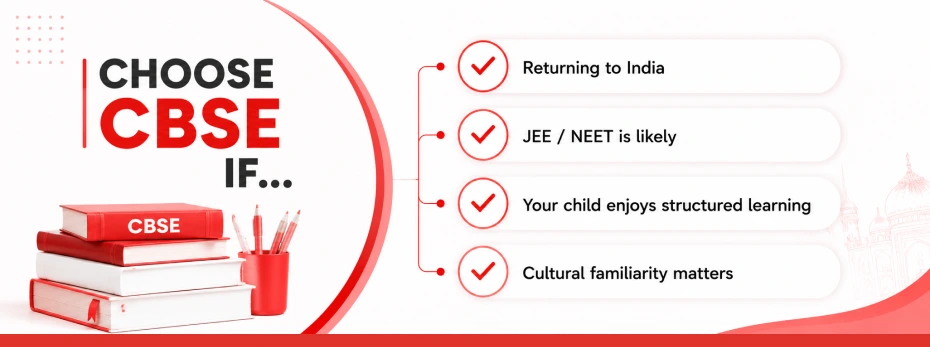
Your family is likely to return to India within the next three to five years. JEE or NEET is a realistic possibility for your child. Your child is already on the CBSE curriculum and performing well. Cultural continuity and familiarity matter significantly to your family’s school experience. Your budget is a primary consideration, CBSE schools in Dubai are generally more affordable than Cambridge IGCSE schools at the premium end of the market.
Choose Cambridge IGCSE if:
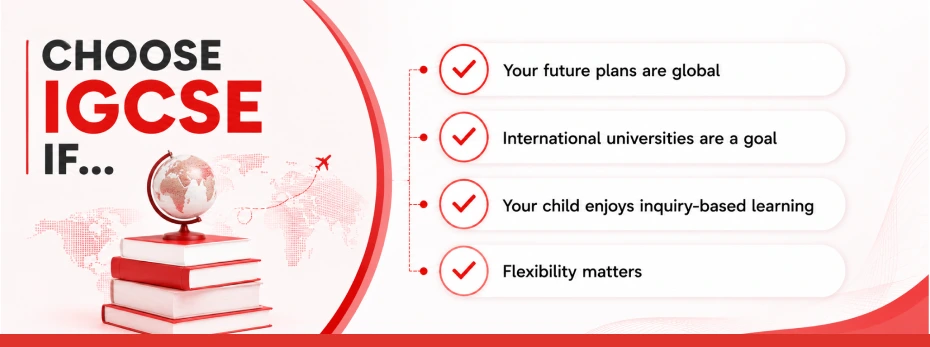
Your family’s long-term destination is uncertain or international. UK, US, Australian, or global university pathways are in view. Your child thrives with analytical, open-ended learning rather than content-heavy examination preparation. You want maximum flexibility in where the qualification is recognised. Your child is transferring from an international curriculum school in another country and continuity matters.
Consider carefully if:
Your child is in Grade 8 or above and you are contemplating a switch. The timing risk is real and worth a direct conversation with the school you are considering.
How Dhruv Dubai School Navigates This
At Dhruv Dubai School, we have this conversation with families regularly and we have it honestly.
We do not tell every family that our curriculum is the right choice for their child. We ask about where the family is headed, what the child’s strengths and learning style look like, and what the realistic university aspirations are. And then we give our genuine assessment of whether our programme is the right fit.
The families who join us on that basis, informed, specific, and clear about why this is the right choice for their child are the families whose children tend to thrive here. Not because we are the right school for every Indian family in Dubai. But because we are genuinely the right school for the families who understand what they are choosing and why.
Final Thoughts
The CBSE vs IGCSE question does not have a universal answer. It has a right answer for your child, one that depends on where you are going, how your child learns, and what kind of educational experience you want them to have in the years between now and university.
The families who navigate this decision most successfully are the ones who ask the question properly. Not which is better? but which is better for us, at this stage, with these plans, for this child?