
Is Your Child Thriving at School or Just Surviving? A Checklist for Parents

That is the word most school-age children use when you ask how their day was. Fine. It covers everything from genuinely happy to quietly falling apart, and from the outside, both can look exactly the same.

This is one of the most disorienting parts of parenting a school-age child. The report card looks reasonable. The teacher has not called. Your child gets up in the morning, goes to school, comes home, does their homework, and goes to bed. The visible machinery of school life is functioning.

But functioning is not the same as flourishing. Surviving is not the same as thriving. And the difference between the two, which is not always obvious from the outside, matters enormously for your child’s long-term wellbeing, confidence, and relationship with learning itself.

This checklist is designed to help you look more carefully. Not with anxiety, but with the kind of informed attention that lets you see what fine is actually covering. Some of what follows will reassure you. Some of it might prompt a conversation with your child, or with the school. Both of those outcomes are good ones.

What It Really Means for a Child to Thrive at School

Before we get to the checklist, it is worth being clear about what thriving means. Because the word is used freely in school marketing and parent conversations, and it has lost some of its precision.

Thriving does not mean being happy every day. School is genuinely difficult at times, and a child who is thriving will still have hard days, frustrating lessons, friendship wobbles, and tests they felt underprepared for. Difficulty is not evidence of suffering. It is often evidence of growth.

Thriving means that underneath the ordinary ups and downs of school life, a child has a stable foundation. They feel safe in their environment. They believe they are capable of learning, even when specific things are hard. They have at least one relationship at school with a teacher, a friend, a group, where they feel genuinely known. They are growing, not just academically but as a person. And crucially, they still have something left over at the end of the day, curiosity, humour, energy for the people they love, rather than arriving home completely depleted and emotionally flat.

Surviving, by contrast, is what happens when a child is spending most of their available resources just getting through. They are managing, but they are managing at a cost. The cost shows up at home, in their body, in their relationship with school, and eventually, in their sense of who they are.

Here is how to tell the difference.

Signs Your Child Is Thriving at School

These are not a guarantee. A child can show most of these signs and still be struggling in ways that are not yet visible. But a child who consistently shows the majority of these is, in most cases, in a genuinely good place.
They talk about school in specific terms.
Not fine or nothing or I don’t know, but actual things. A conversation someone had. Something that happened in Science that they found interesting, or confusing, or funny. A specific teacher’s name used in context. The child who says “we did this thing in Maths today where…” is a child who is engaged enough with their school day to have retained it and wants to share it. That specificity is a meaningful signal.
They have at least one friendship they genuinely value
Not twenty friends. One. A child who has one person at school they look forward to seeing, who they talk about at home, who they have some form of genuine mutual connection with, has something that protects them through almost everything else school throws at them. Friendship is the single strongest predictor of school wellbeing across every age group in the research. One real one is worth more than a wide circle of shallow ones.
They move between school mode and home mode
A child who is thriving can switch off from school when they get home. They play, they are silly, they argue about what to watch, they eat with appetite. The school day has not consumed them so entirely that there is nothing left. If your child comes home and immediately retreats, cannot engage with the family, shows no appetite, and seems to carry the weight of the day long into the evening that depletion is worth paying attention to.
They can tolerate getting things wrong
This is one of the most reliable markers of genuine confidence, as opposed to performance. A child who can say I got that wrong, I need to try a different way without it becoming a crisis is a child who has a secure enough relationship with their own capability that failure does not threaten it. The child who dissolves at a disappointing grade, who refuses to attempt things they might not immediately succeed at, or who hides mistakes rather than acknowledging them, is often a child whose sense of self is more fragile than the surface suggests.
They occasionally push back on something at school and tell you about it
The child who comes home and says I think my teacher marked that unfairly or I don’t agree with how that group project worked is a child who feels safe enough in their school environment to have opinions about it. That critical engagement is a healthy sign. The child who never expresses any dissatisfaction, who agrees with everything and reports everything as perfect, is sometimes thriving. Sometimes they have learned that complaints are not safe to make.
They are curious about things beyond their homework
A child who is genuinely thriving intellectually does not stop thinking when the school bell rings. They ask questions at dinner that came from something they wondered about during the day. They want to look something up. They connect what they learned in school to something they saw in the world. Curiosity that extends beyond the assignment is one of the clearest signals that school has not killed a child’s relationship with learning, which is no small thing.
They sleep reasonably well and wake without significant dread
Sleep is one of the body’s most honest reporters. A child who falls asleep without prolonged anxiety and wakes in the morning without the immediate arrival of intense reluctance is a child whose nervous system is not in sustained threat-response mode about school. Persistent sleep difficulty, particularly difficulty falling asleep accompanied by worry, is one of the earliest physical signs that something at school is creating more stress than the child can comfortably manage.
They occasionally choose to do something school-related in their own time

Not homework. Something chosen. Reading about a topic that came up in class. Drawing a diagram they found interesting. Looking up a historical figure they heard about. Teaching a younger sibling something they recently learned. These moments, small, unremarkable, completely voluntary are the most genuine evidence of thriving that exists. A child who chooses learning is a child whose relationship with learning is intact.
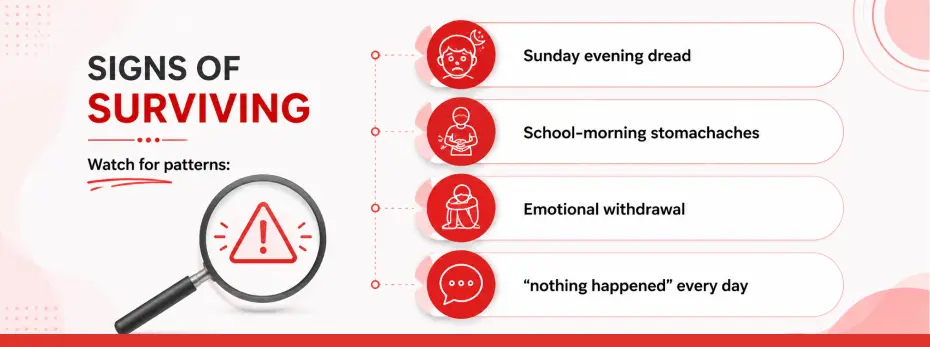
Signs Your Child May Be Struggling at School

These are not a diagnosis. One or two of these, occasionally, in an otherwise settled child, are likely just the ordinary noise of a difficult week. A cluster of several, sustained over more than two to three weeks, is worth taking seriously.
They never talk about their day
Nothing happened. I don’t remember. It was fine. Every child has days like this. But a child who never has anything to say about school, who cannot retrieve a single specific moment from six or seven hours is a child who is either deeply disengaged, actively avoidant of the topic, or so socially isolated that the days blur into undifferentiated sameness. Any of those possibilities is worth a gentle, unhurried conversation.
Sunday evenings are consistently difficult
The Sunday evening dread is one of the most widely recognised signs that a child’s relationship with school has become primarily one of endurance rather than engagement. Stomachaches, tearfulness, irritability, sleep difficulty, or explicit reluctance that reliably appear on Sunday evenings and resolve by Monday afternoon are the body communicating something the child may not yet have the words for.
They have stopped talking about any specific friend
Friendship is not static, particularly in the middle school years. But a child who has gone quiet about their social world, who no longer mentions anyone by name, who does not have plans, who seems socially isolated without being able to explain why, may be experiencing something in their peer relationships that they do not know how to bring home.
They are frequently unwell on school mornings

Stomachaches and headaches on school mornings that resolve during holidays, or that clear up by mid-morning once the school decision has been made, are among the most consistent physical presentations of school-related anxiety. The body is not pretending. The pain is real. But its timing is meaningful.

Their relationship with school is entirely transactional
They do what is required. They hand things in. They attend. But there is no investment, no spark, no moments of genuine enthusiasm. School is something that happens to them, not something they participate in. A child who has reduced their relationship with school to pure compliance, doing exactly enough to avoid consequence and nothing more has usually made that choice because genuine engagement has at some point felt too costly or too risky.
They seem smaller at home than they used to
This one is hard to put into words, but parents almost always recognise it when they reflect carefully. A child who is surviving rather than thriving often seems somehow diminished, less willing to try things, less confident in their own opinions, more self-critical, quicker to give up. The confidence that should be building with each passing school year is not building. Something is quietly eroding it instead.
They express a general hopelessness about school
Not I found that test hard but I’m just not good at school. Not I didn’t like that lesson but I hate it there. Generalised, fixed negative self-talk about school and about their own capability is not an attitude. It is a signal. A child who has begun to form a settled belief that they cannot succeed, or that school is fundamentally hostile to them, is a child who needs support before that belief becomes the story they tell about themselves for the next decade.

What Parents Should Do If Their Child Is Struggling

The first thing and it is genuinely the most important thing is not to panic. A child showing several of the surviving signs is not a child in crisis. They are a child whose environment needs adjusting, whose support needs strengthening, or whose voice needs to be heard more clearly.

Start at home. Create the conditions for an honest conversation without making it feel like an interrogation. Side-by-side conversations, in the car, on a walk, during a shared meal are far more productive than face-to-face ones for most children and virtually all teenagers. Ask open questions. Be genuinely curious rather than visibly worried. Listen twice as long as you speak.

Then go to school early. Not when things have become a significant problem, but at the first sustained sign that something is not right. A brief, honest conversation with a teacher or pastoral lead, “I noticed some things at home and I wanted to check what you are seeing”, is exactly the kind of conversation schools want to have early. It is always more productive than the conversation that happens after six months of hoping things will resolve on their own.

And if what you find requires more than a pastoral conversation, if there is evidence of bullying, of a significant learning difficulty that has gone unidentified, of anxiety or low mood that is affecting your child’s daily functioning, go further. Ask what the school’s support pathway looks like. Request a formal meeting. If needed, seek external support. Early intervention in all of these areas produces outcomes that late intervention cannot.

School Wellbeing Checklist for Parents

Print this, photograph it, keep it somewhere useful. Come back to it at the start of each new term.

Signs of Thriving:

  • Talks about school in specific, concrete terms
  • Has at least one genuine friendship
  • Switches off from school at home, eats, plays, engages
  • Can tolerate mistakes without collapse
  • Occasionally disagrees with something at school and says so
  • Shows curiosity beyond the homework
  • Sleeps well and wakes without intense dread
  • Occasionally chooses something school-related in their own time

Signs of Surviving:

  • Cannot recall anything specific about their day, consistently
  • Sunday evenings are reliably difficult
  • No longer mentions any friends by name
  • Frequent unexplained illness on school mornings
  • Occasionally disagrees with something at school and says so
  • Purely transactional relationship with school, does enough, nothing more
  • Seems less confident than they used to be
  • Fixed, generalised negative self-talk about school or their own ability

A Final Word

There is a version of school success that looks fine from the outside and costs a child everything on the inside. There is another version, quieter, less immediately legible in grades and prizes, where a child is genuinely building something: confidence, curiosity, resilience, and a sense of their own capability that will carry them far beyond any individual result.

The difference between those two versions is worth finding out. Not once, not at parents’ evening, but consistently, in the small conversations, the Sunday evenings, the way they walk through the door, the things they say and the things they do not.

Your child is spending the majority of their waking hours at school. You deserve to know how those hours actually feel.


Frequently Asked Questions

Stop asking directly and start being present indirectly. Children, particularly teenagers, rarely open up in response to a frontal question. They open up when they feel genuinely safe, when the conversation has no obvious agenda, and when they sense that the person asking can handle what they might say. Create those conditions consistently and the conversation usually follows.
Yes. Grades are a narrow measure of a narrow range of things. A child can perform academically while simultaneously experiencing significant social difficulty, chronic anxiety, or profound disengagement from learning. Academic performance and genuine wellbeing do not always move together. If something feels off, it is worth investigating regardless of what the report card says.
More often than most parents do, and less formally than many fear. A brief, friendly email to a form teacher at the start of each term, how are you finding X this term, anything you are noticing?, takes five minutes and creates a channel of communication that serves everyone when something more significant emerges. You do not need to wait for parents’ evening.
A period of adjustment after a school change is completely normal, particularly in the first term. If the surviving signs are still prominent after two full terms, however, the school change itself may need to be examined, whether the environment, the academic fit, or the social dynamics are genuinely working for this particular child