
You have been given ten minutes. In those ten minutes, you are supposed to find out how your child is doing academically, socially, and emotionally, across every subject, with every teacher and form a clear picture of what the next term should look like for them. You will probably have to wait five minutes before your slot begins. There will be a chair that is slightly too small. The teacher will be on their fifteenth consecutive meeting of the evening and working from notes they wrote at lunchtime.
And then, somehow, ten minutes are up. Most parents leave parent–teacher conferences with a general impression, seems okay, teacher seems nice, got a few things to think about, rather than the specific, actionable understanding they actually needed. Not because the teacher was unhelpful. Not because the parent did not care. But because the format is genuinely difficult, and almost nobody teaches parents how to use it well.
Why Parent–Teacher Conferences Matter More Than Most Parents Realise
It is easy to treat the parents’ evening as a formality. A box to tick. A chance to confirm what you already suspect, or to be reassured that everything is fine.
But a parent–teacher conference, used well, is one of the most valuable educational interventions available to a family. It is the moment when the two people who know your child best in their respective worlds: home and school are in the same room, with time set aside specifically to compare those two pictures.
Because those two pictures are often genuinely different. The child your child’s teacher sees and the child you see at home are frequently not quite the same person. The child who is confident and opinionated at the dinner table may be quiet and self-effacing in class. The child who seems effortlessly capable at home may be working extremely hard to maintain that appearance at school. The child who claims everything is fine may be struggling in ways that only become visible when two sets of observations are laid alongside each other.
That comparison, home picture and school picture placed next to each other — is where the most useful insights come from. And it only happens if both parties come to the meeting prepared to share genuinely, listen carefully, and leave with something more than reassurance.
Before You Walk In: Preparing for a Parent–Teacher Conference
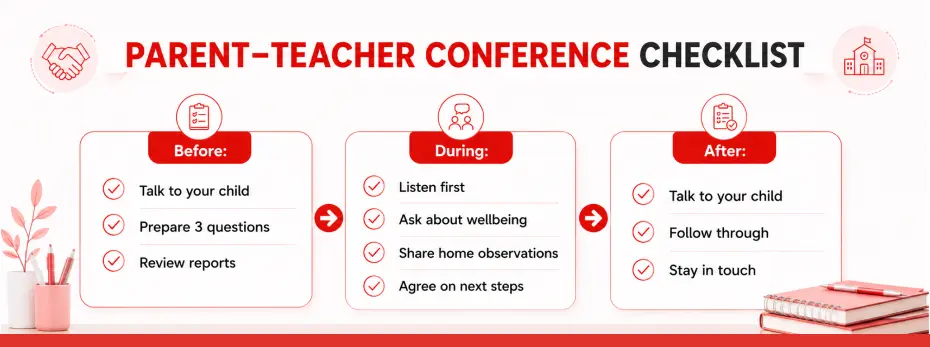
Talk To Your Child First
This is the step most parents miss, and the one that makes everything else more useful. Before you sit down with your child’s teacher, sit down with your child. Ask them how they feel about school at the moment. What they find easy, what they find hard. Whether there is anything they wish their teacher knew about them. Whether there is anything they would like you to raise.
Two things happen when you do this. First, you arrive at the meeting with a richer, more specific picture of your child’s experience than any observation you could make from the outside. Second, you communicate to your child that the meeting is happening for them, not about them, which significantly reduces the anxiety many children carry about parents’ evening and makes them more willing to engage with whatever comes out of it.
Some children will not say much. Some will give you a list. Either way, you have opened a channel that makes the follow-up conversation after the meeting far more productive.
Write Down Your Questions In Advance.
Ten minutes sounds short because it is short. A prepared parent with three specific questions will extract more genuine value from that time than an unprepared parent given thirty minutes. Write your questions before you arrive. Not a wishlist of every concern that has crossed your mind since September, three focused, specific questions that reflect what you most need to understand about your child’s current experience.
Good questions are specific. Not how is she doing? but she has mentioned feeling behind in maths, is that matching what you are seeing? Not does he have friends? but I have noticed he rarely talks about anyone from school by name, is he socially connected in the classroom?
Specificity signals to the teacher that you are genuinely engaged rather than passively receiving, and it produces specific answers rather than general reassurances.
Review Any Recent Work Or Reports Beforehand
How to Make the Most of Your Time with Teachers
Start By Listening, Not Asking
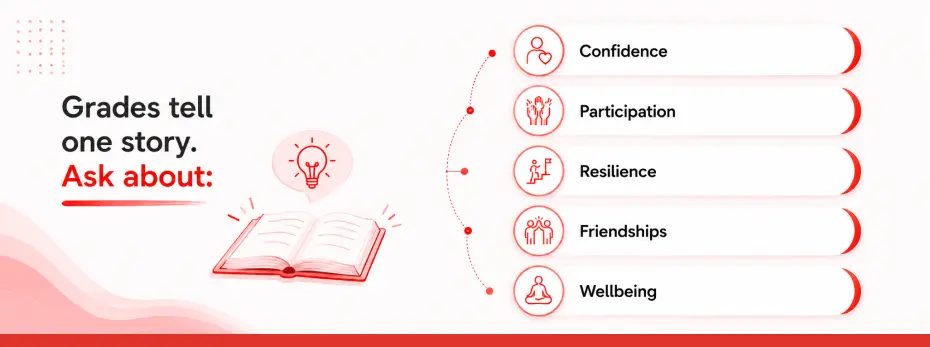
Ask About The Whole Child, Not Just The Grades
Grades are the easiest thing to discuss and often the least illuminating. A B+ tells you your child produced work of a certain standard. It does not tell you whether your child is happy, challenged, growing in confidence, struggling socially, or feeling connected to their learning.
Ask specifically about things the grade cannot capture. Does my child contribute in class? Do they ask questions when they do not understand, or do they let confusion accumulate? How do they respond when something is difficult? Do they have genuine friendships in this class? Is there anything about how they seem emotionally that you have noticed?
These questions often produce the most valuable information of the entire meeting and they are almost never asked.
Share What You Are Seeing At Home
This is the part of the meeting that parents most often forget they have a role in. The teacher is not there to deliver a verdict while you receive it. You are there to exchange observations.
Tell the teacher what you are noticing at home. If your child comes home stressed on certain days, say so. If they light up talking about a particular subject or project, say so. If they are not sleeping well, if their appetite has changed, if they have been more anxious than usual, if there has been something significant happening in the family, say so. Not everything, not in inappropriate detail, but enough that the teacher can adjust their understanding of what they are seeing in the classroom.
Teachers make sense of children’s classroom behaviour with the information they have. Information from home can completely reframe a behaviour that was previously puzzling. That reframing changes how the teacher responds and that changed response changes the child’s experience. This exchange is the whole point of the meeting.
Name The Specific Thing You Are Most Concerned About
If there is something you are genuinely worried about, not a vague sense that something is not quite right, but a specific, concrete concern, say it clearly. Do not hint at it and hope the teacher picks it up. Do not save it for the last thirty seconds when there is no time to explore it.
Many parents hedge their real concerns in parent–teacher conferences because they do not want to seem like a difficult parent, or because they are worried the concern will be dismissed, or because they are not entirely sure whether what they have noticed is worth raising. Raise it anyway. A good teacher will engage with it seriously. If the concern is dismissed too quickly, that is itself useful information about the teacher and the school.
Ask What You Can Do At Home
This is the question that converts a conference from a progress report into a partnership. Not how is she doing? But what is the one thing I could do at home this term that would make the biggest difference for her?
This question does several things simultaneously. It signals that you are genuinely engaged and willing to act. It gives the teacher something concrete to offer rather than general encouragement. And it gives you something specific to take home and actually do, rather than a general sense that you should be supporting your child more.
The answer might surprise you. It is often not academic. A teacher might say: give him five minutes every morning to talk about what he is looking forward to that day. Or: she needs to know that it is okay not to be the best at things, she puts enormous pressure on herself. Or: he would benefit from more unstructured play time at home. These are things a grade cannot tell you.
How to Discuss Concerns with a Teacher Effectively
Some parent–teacher conferences carry heavier material. A child who is significantly behind. A social situation that has become problematic. Concerns about wellbeing. Behaviour that is causing difficulty in the classroom.
These conversations require a slightly different approach, and one thing above all else: stay in the room.
The natural response to difficult information about your child, defensiveness, deflection, the urge to explain why the school must be wrong is understandable and almost always counterproductive. A teacher who shares a genuine concern with a parent is taking a professional risk. If that risk is met with hostility, the teacher learns to share less next time. And less information means less opportunity to help.
Receive difficult information with curiosity rather than defensiveness. Ask questions rather than making counter-arguments. That surprises me, can you tell me more about what you are seeing? is always a more productive response than he is not like that at home. Both things can be true. In fact, the gap between how a child behaves at school and at home is often one of the most diagnostically useful things a teacher and parent can explore together.
If the information is serious, a learning difficulty that may need formal assessment, a wellbeing concern that has been escalating, ask directly what the next step is, who will take it, and by when. Do not leave the meeting without a clear agreed action and a clear agreed timeline. Schools move faster on things when parents have specifically asked about the timeline.
What to Do After a Parent–Teacher Conference
The parent–teacher conference does not end when you leave the room. What you do in the twenty-four hours after the meeting determines whether it changes anything.
Talk To Your Child About It
Your child has been waiting, probably anxiously, to find out what was said. Tell them something genuine. Not a filtered, entirely positive version that protects them from all difficult information, children know when they are being managed, and it erodes trust. And not a report of every concern that was raised, which creates anxiety without context.
Tell them one thing the teacher said that was genuinely positive. Tell them one thing that the teacher mentioned that you would like to work on together. Frame the conversation as collaborative, your teacher and I want to help you with this, and we wanted to know what you think would help, rather than as a verdict being handed down.
A child who is included in the follow-up to a parents’ evening is a child who feels some ownership over their own education. That feeling of ownership is one of the strongest motivators in a young person’s academic life.
Follow Through On What You Said You Would Do.
If you told the teacher you would increase reading time at home, do it. If you said you would speak to your child about something, speak to them. If you agreed to monitor something and report back, monitor it and report back.
This matters not because teachers are checking up on you, but because the parent who follows through is the parent whose child’s teacher invests more. Teachers are human. They notice when a parent has done what they said they would. And that noticing changes the quality of attention a teacher brings to a child’s progress, not dramatically, not unfairly, but in all the small ways that accumulate across a school year.
Send A Brief Follow-Up If Necessary
If the meeting revealed something significant, or if there was not enough time to fully address a concern, send a short email within a few days. Not a lengthy debrief, just an acknowledgement of what was discussed, confirmation of any actions you are taking, and an open door for further conversation. This keeps the dialogue alive between now and the next formal conference, which matters because the things that need most attention rarely wait for scheduled meetings.
A Few Questions Worth Having Ready
Not all of these will apply to every meeting. But having a few in your back pocket means you will never find yourself sitting in silence while the time runs out.
- Is my child working to their potential, or is there more in there that is not yet coming through?
- Is there a subject or area where they have shown unexpected growth recently?
- How do they respond when something is genuinely difficult, do they persist, or do they tend to disengage?
- Is there anything about their social experience in this class that I should know?
- If you could tell me one thing about my child that their grade does not capture, what would it be?
- What does success look like for my child by the end of this year, not just academically, but as a person?
That last question, asked with genuine curiosity, produces some of the most honest and useful conversations a parent and teacher can have. It moves the frame from performance to growth. And growth, real, human, whole-child growth is what both parties are actually there for.
How Dhruv Dubai School Approaches Parent–Teacher Conferences
At Dhruv Dubai School, parent–teacher conferences are not a formality we move through twice a year. They are one of the most important touchpoints in the partnership between school and family and we prepare for them as carefully as we ask parents to.
Our teachers come to every conference having reviewed not just grades but the full picture of each student: their social dynamics, their emotional patterns across the term, the moments of unexpected strength and the areas where something has shifted. We bring observations that go beyond the markbook, because we know that the markbook is only one part of the story.
We also make time for the difficult conversations, the ones that parents sometimes hesitate to start and teachers sometimes hesitate to raise. We would rather have those conversations in a ten-minute meeting than in a crisis that could have been avoided by having them earlier.
If you leave a conference at Dhruv Dubai School with nothing more than a reassurance that your child is fine, we have not done our job properly. You should leave with something specific, something honest, and something you can act on.
Final Thoughts
Ten minutes is not much. But it is enough, if you walk in knowing what you need, ask the questions that actually matter, share what you are genuinely seeing, and leave with something you can do.
The parent–teacher conference is not a report card delivered in person. It is a conversation between the two adults who care most about your child’s experience of school. When that conversation is honest, specific, and focused on the whole child rather than just their performance, it changes things. Not dramatically, not overnight, but in all the small, cumulative ways that a school year is actually made of.
Your child is in that building for six or seven hours every day. You deserve to know what those hours look and feel like. And the teacher sitting across from you, in the slightly-too-small chair, with the notes they wrote at lunchtime, they want you to know too.
Show up prepared. Ask the real questions. And stay in the conversation long after the ten minutes are up.