
Parents often look for the big lever, the right tutor, the right school, the right exam strategy, when trying to improve how a child learns. But research on learning consistently points somewhere far less dramatic: the daily habits surrounding sleep, routine, reading, and screen time do more to shape a child’s academic performance than almost any single intervention.
This matters especially for families managing busy, international schedules, where consistency can be harder to maintain. This blog breaks down what the research actually shows about daily habits that improve learning, and how small, repeatable routines compound into meaningfully better outcomes over a school year.
Why Habits Matter More Than Willpower
8 Daily Habits That Help Children Learn Better
1. Sleep: The Single Most Underrated Learning Habit
If there is one habit with the most consistent research behind it, it is sleep. During sleep, the brain consolidates what was learned during the day, transferring information from short-term to long-term memory. A child who studies well but sleeps poorly will typically retain less than a child who studies moderately but sleeps consistently and sufficiently.
Sleep researchers generally recommend 9 to 11 hours for primary-age children and 8 to 10 hours for teenagers, figures many families, particularly with late school-night schedules or long commutes, fall short of without realising it.
Sleep and Learning: What the Research Shows
- Sleep consolidates memory, it is when learning is actually stored, not lost
- Poor sleep directly impairs attention, problem-solving, and emotional regulation the next day
- A consistent bedtime and wake time matters as much as total hours slept
- Screen use in the hour before bed measurably delays and disrupts sleep quality
2. A Predictable Daily Routine
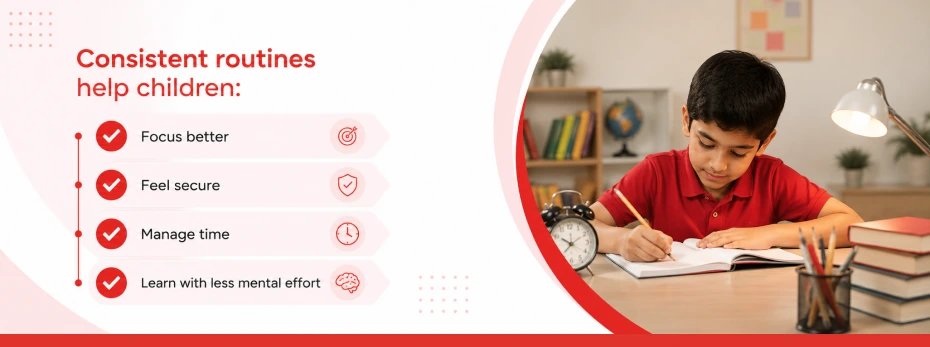
A predictable routine, consistent wake times, meal times, homework windows, and bedtimes, reduces the mental load a child carries through the day. When the structure of a day is familiar, a child’s brain has more capacity left over for actual learning, rather than managing uncertainty about what happens next.
This is particularly relevant for families balancing international schedules, travel, or shifting time zones. The more anchored a child’s daily rhythm remains despite external change, the more stable their capacity to focus and learn.
3. Reading for Pleasure, Every Day
Daily independent reading, even just 15 to 20 minutes of a book a child has chosen themselves, is one of the most consistently supported habits in literacy research. It builds vocabulary, comprehension, and general knowledge in a way that compounds over years, far beyond what reading assigned for homework alone achieves.
The key detail researchers emphasise is choice: reading a child actually wants to do produces stronger gains than reading assigned purely as a task, because the child is more likely to sustain the habit and engage attentively with the material.
4. Managed, Not Eliminated, Screen Time
The relationship between screen time and learning is more nuanced than a simple “less is better” rule. Passive screen use, endless scrolling or unstructured video content, is consistently linked to shorter attention spans and reduced reading habits. Active, purposeful use, educational content, research, or creative tools, shows far less negative effect.
What matters most is not just quantity but timing and boundaries: screens displacing sleep, reading, or outdoor play are where the real cost shows up, more than screen time in isolation.
5. Physical Activity Every Day
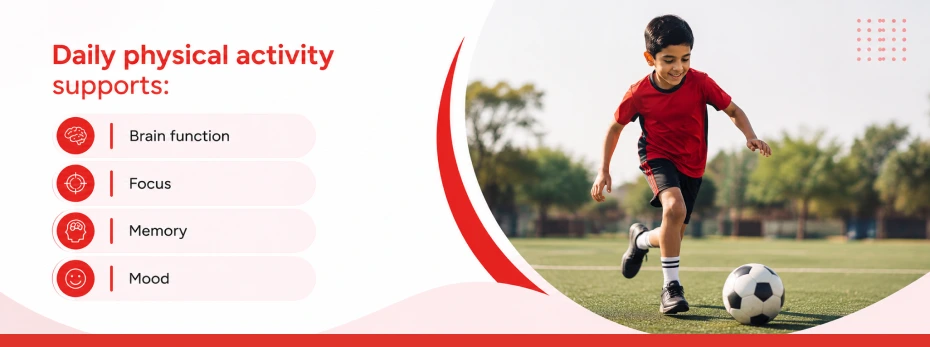
Regular physical activity has a direct, measurable effect on cognitive function, not just physical health. Exercise increases blood flow to the brain and supports the growth of new neural connections, particularly in areas related to memory and executive function. Even a daily 30-to-60-minute block of active play or sport meaningfully supports a child’s ability to focus during study time.
6. A Fixed, Short Homework Window
Long, unstructured homework sessions tend to produce diminishing returns. A fixed homework window, the same time and place each day, with a clear start and end, tends to be more effective than an open-ended “whenever it gets done” approach, because it removes the daily negotiation over when to start and creates a consistent cue for focus.
A Simple Daily Framework Worth Building Toward
- 1. Consistent wake and bedtime, seven days a week, including weekends
- 2. 15–20 minutes of independent reading, chosen by the child
- 3. A fixed homework window at the same time and place each day
- 4. At least 30–60 minutes of physical activity
- 5. Screens off at least 45–60 minutes before bedtime
- 6. A few minutes of conversation about the school day, not just "how was school?"
7. Daily Conversation About Learning
A short daily conversation about what a child learned, found interesting, or found difficult reinforces learning far more than parents often expect. Asking specific questions, “what was the most interesting thing you learned today?” rather than the general “how was school?”, encourages a child to actively retrieve and articulate what they learned, which is itself a powerful memory-strengthening exercise known as retrieval practice.
8. Nutrition and Hydration Through the School Day
Blood sugar and hydration levels have a direct, short-term effect on concentration and memory. A child who skips breakfast or arrives at school under-hydrated will typically show measurable dips in attention by mid-morning, regardless of how much they studied the night before. Steady, balanced meals, rather than sugar-heavy snacks that spike and then crash energy, support more consistent focus across a school day.
This is a particularly easy habit to overlook amid busy mornings, but it is also one of the simplest to build: a protein-inclusive breakfast, a water bottle that actually gets used through the day, and snacks that sustain rather than spike energy.
Why Consistency Matters More Than Intensity
None of these habits require dramatic effort individually. Their power comes from consistency over time; a 20-minute reading habit repeated daily across a school year adds up to far more reading than an occasional two-hour session ever could. The same logic applies to sleep, exercise, and homework routines: small, repeated actions compound in a way that occasional intense effort simply cannot match.
How Dhruv Global School Dubai Supports These Habits
At Dhruv Global School Dubai, we know that what happens outside the classroom shapes what is possible inside it. Our academic team works closely with families to build consistent daily rhythms around school life, from realistic homework loads that fit within a focused window, to encouraging independent reading as a daily habit rather than an occasional assignment.
Our approach also reflects the understanding that physical activity and downtime are not distractions from learning but a genuine part of it. Structured time for sport and active play is built into the school day, alongside a calm, predictable daily routine that helps students, particularly those balancing international family schedules, feel grounded and ready to focus.
We regularly share guidance with parents on building strong routines at home, because we see, consistently, that the students who thrive academically are rarely the ones doing the most, they are the ones doing the right small things, every day.
Final Thoughts
Improving how a child learns rarely comes down to one big change. It comes down to sleep, routine, reading, movement, and conversation, repeated daily, without needing to be perfect every single day. Build these habits gradually, and the results tend to show up not in a single test, but across an entire school year.