

When parents visit a school open day in Dubai, extracurricular activities tend to feature prominently in the tour. The swimming pool. The robotics lab. The performing arts theatre. The sports fields. The wall of photographs showing children holding trophies.
And then, in the car on the way home, the conversation almost always returns to the other things. The KHDA rating. The exam results. The university placement statistics.
Extracurriculars are treated, by most families, as a pleasant addition to the academic programme. A signal that the school is well-rounded. A source of enjoyment for children who like sport or music. Something to mention on a university application when the time comes.
What they are not treated as and what the research says they actually are, is one of the most significant contributors to a child’s cognitive development, emotional resilience, social capability, and long-term achievement.
This is the conversation most schools do not have explicitly enough. And the one that changes how parents think about what their child’s after-school hours are actually for.
What Extracurricular Activities Actually Are
The term is broader than most parents realise, and worth defining precisely.
Extracurricular activities are structured pursuits that take place outside formal curriculum lessons, but within the school’s educational programme. They include sport, music, drama, debate, art, coding clubs, robotics, Model United Nations, community service, environmental projects, school publications, chess, and a significant range of other activities depending on the school.
What distinguishes a genuine extracurricular programme from a timetable of after-school babysitting is structure, progression, and genuine challenge. A child who attends football training twice a week, develops their skill over a season, competes against other schools, experiences victory and defeat, and reflects on how they performed is doing something educationally significant. A child who is taken to a field once a week and left to kick a ball around is not.
The quality of the extracurricular programme, the thoughtfulness with which it is designed, the expertise of the people leading it, the seriousness with which the school treats it as educational rather than recreational, determines whether a child is genuinely developing or simply occupied.
In Dubai’s premium school market, where new schools opening in 2025–26 are explicitly marketing Olympic pools, innovation labs, performing arts centres, and AI-focused programmes as differentiators, this distinction matters more than ever. Impressive facilities are not a programme. What happens inside them is.
What the Research Actually Says
The evidence on extracurricular participation is substantial, consistent, and largely unknown to parents who have not specifically sought it out.
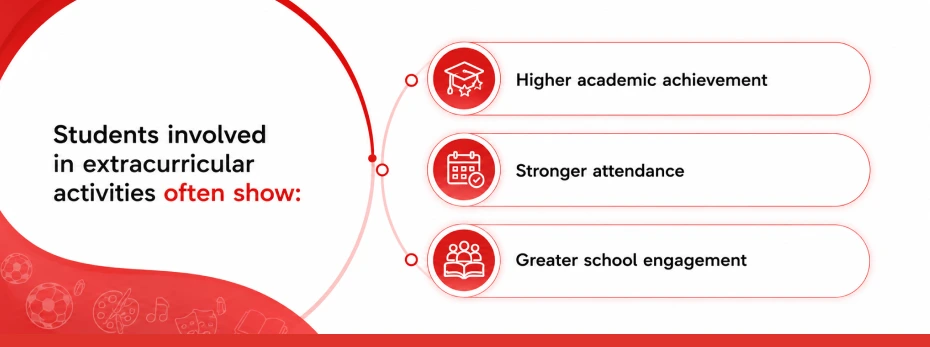
Students who participate in extracurricular activities demonstrate higher academic achievement than non-participants, not because academically stronger students self-select into activities, but because participation itself produces the outcome. Longitudinal studies that control for prior attainment consistently show that extracurricular involvement improves grades, attendance, and engagement with academic work.
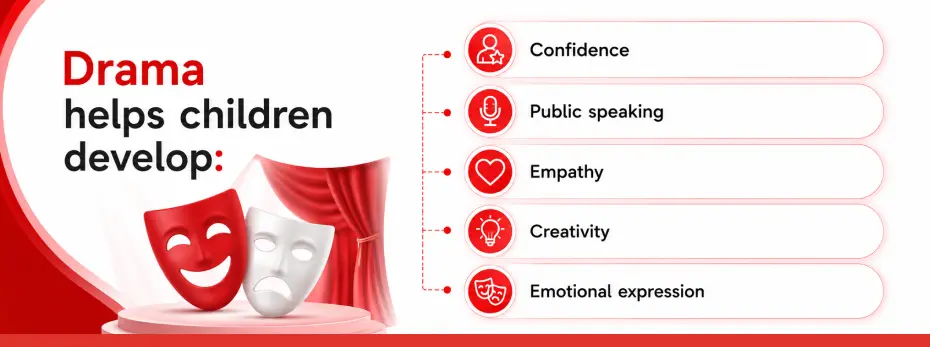
The mechanism is not mysterious. Physical activity increases blood flow to the prefrontal cortex — the part of the brain responsible for attention, working memory, and executive function. A child who trains for sport several times a week arrives in the classroom with better cognitive capacity than one who does not. Music training develops auditory processing, working memory, and mathematical reasoning simultaneously. Drama builds the ability to take another person’s perspective, theory of mind, which is one of the strongest predictors of social and academic success.
Beyond cognitive outcomes, extracurricular participation is one of the strongest predictors of wellbeing. Students who have at least one activity they are genuinely committed to, one context outside the classroom where they feel capable and connected, demonstrate significantly lower rates of anxiety, depression, and school disengagement than those who do not.
This is particularly important in Dubai’s high-pressure academic environment, where competition for school places, parental expectations around academic performance, and the social pressures of an internationally diverse student body combine to create a climate of anxiety that affects children across every year group.
An extracurricular commitment is not a distraction from managing that pressure. It is one of the most effective buffers against it.
What Different Activities Actually Develop
Not all extracurricular activities develop the same things. Understanding what specific activities build helps parents think more precisely about what their child needs — rather than simply choosing whatever is most convenient or most popular.

Sport
Sport is the most widely offered and most widely misunderstood extracurricular activity in schools. Its benefits extend considerably beyond the physical.
Competitive sport, sport that involves training, strategy, teamwork, and genuine competition against others, develops resilience in a way that is almost impossible to replicate elsewhere. A child who has experienced the specific pain of a close defeat, sat with it, returned to training the next day, and competed again has developed something that no classroom lesson can build: the lived knowledge that failure is not final.
Team sport specifically develops the ability to subordinate personal performance to collective goals, to pass when shooting would feel better, to support a teammate who is struggling, to trust that your role in the system matters even when you cannot see the whole picture. These are not peripheral life skills. They are the skills of every functional team, organisation, and community your child will ever be part of.
Individual sport, swimming, athletics, tennis, martial arts, develops a different dimension of the same resilience. Without teammates to share the responsibility, the individual athlete confronts their own performance directly and honestly. The relationship between effort and outcome is more transparent and more demanding. Children who pursue individual sports to a serious level typically develop exceptional self-discipline and an unusually clear understanding of what sustained practice actually produces.

Music
The cognitive benefits of music education are among the most thoroughly researched in developmental psychology and among the most consistently underestimated by parents and schools.
Learning an instrument develops fine motor control, auditory processing, mathematical reasoning, working memory, and the ability to sustain attention over extended practice sessions. Brain imaging studies consistently show that trained musicians have more developed connections between the brain’s auditory and motor regions than non-musicians, connections that support learning across every academic domain.
Playing in an ensemble, an orchestra, a band, a choir, adds the social dimensions. Reading your part while listening to the whole. Adjusting your timing, your volume, your interpretation in real time in response to what others are doing. This is sophisticated cognitive and social coordination, practised repeatedly in a context that is genuinely enjoyable, which is why its effects transfer so broadly.
A child who has played in an ensemble for three years arrives in a collaborative academic project with a set of coordination and communication skills that their non-musician peers frequently lack. They have practised the specific discipline of contributing a part to a whole, of being individually excellent in service of something larger than themselves.
Drama and Performing Arts
Drama is the extracurricular activity most consistently undervalued by academically ambitious families and the one that most directly develops the capabilities that those families most want their children to have.
Standing in front of an audience and performing is one of the most cognitively and emotionally demanding things a school-age child can do. It requires the memorisation and precise recall of text. The ability to embody a perspective entirely different from one’s own. The management of performance anxiety in real time. The coordination of voice, body, and intention simultaneously. And the willingness to fail publicly, to forget a line, to miss a cue, to recover in front of a watching audience and continue.
Children who do drama regularly develop communication confidence that distinguishes them in every subsequent context. The child who has performed in school productions does not find job interviews, university admissions presentations, or professional public speaking particularly frightening, because they have already done something harder.
They also develop empathy. Playing a character whose life is different from your own, inhabiting their perspective, making their choices, feeling their consequences, builds the theory of mind that is the foundation of every human relationship worth having.
Debate and Model United Nations
These activities develop the specific cognitive and communication capabilities that the most demanding university programmes and the most competitive professional environments reward most.
Debate requires a student to construct an argument, anticipate counter-arguments, find the flaw in opposing reasoning, and communicate all of this under pressure and within strict time constraints. It is one of the most direct builders of critical thinking available in a school setting and the only extracurricular activity that explicitly teaches the ability to argue a position you do not personally hold, which is an extraordinary cognitive discipline.
Model United Nations extends this into a social and strategic dimension, requiring students to research complex geopolitical issues, represent a position with fidelity to a country’s actual foreign policy interests, negotiate with other delegations, and draft resolutions that can command a coalition of support.
Students who have participated seriously in debate or MUN arrive at university seminars, law school tutorials, and professional meeting rooms with a fluency in structured argumentation that their peers consistently lack. It is among the most directly transferable extracurricular experiences available at school level.
Community Service and Environmental Projects
These are the activities that develop what might be called civic intelligence, the understanding that one exists within a community that has needs, and that one has a responsibility toward it.
For students at international schools in Dubai, whose lives are often lived within a relatively insulated expat bubble, community service provides contact with realities beyond their immediate social world. It builds empathy not as an abstract value but as a practised response to specific human situations. It develops the organisational and leadership skills that come from actually making something happen, running a fundraiser, coordinating a volunteer group, managing a project with real stakes and real beneficiaries.
Universities, particularly in the UK and US, weigh community service heavily in admissions, not because they want students who have completed a required number of service hours, but because genuine sustained community engagement signals the kind of character and motivation that makes a student an asset to a university community. The distinction between performed service and genuine commitment is almost always visible in a personal statement, and admissions officers are experienced at seeing it.
How Extracurricular Activities Work in Practice at Dubai Schools
Dubai’s premium school market has raised parental expectations around extracurricular provision considerably. New schools opening in 2025–26 are explicitly competing on the quality and range of their activity programmes, innovation labs, Olympic pools, performing arts centres, and specialist coaching staff are all being used as admissions differentiators.
For parents evaluating schools, the questions worth asking go beneath the facilities.
How many activities are genuinely available, as opposed to theoretically available? Some schools list forty activities on their website and deliver twelve reliably. Ask to see the current term’s activity schedule and enrolment numbers.
Are activities led by specialist staff or by classroom teachers managing an additional commitment? A music programme led by a professional musician produces different outcomes from one led by a generalist teacher whose primary identity is elsewhere.
What is the school’s philosophy around participation? Some schools make extracurricular participation compulsory for all students, which ensures that every child has the experience of committing to something beyond the classroom. Others leave it entirely optional, which means the children who most need the developmental benefits of extracurricular engagement, the anxious, the socially isolated, the academically pressured, are the ones least likely to self-select into activities.
How are activities connected to the academic programme? The schools that produce the strongest all-round outcomes are those where extracurricular learning is taken seriously as learning, where the skills developed in the drama studio or on the sports field are acknowledged, reflected upon, and connected to the wider education the school is offering.
The University Admissions Piece Without Overstating It
It is worth addressing this directly because it is the lens through which many Dubai parents primarily view extracurricular activities and because both overstating and understating it does families a disservice.
UK university applications, through UCAS, are primarily academic. Grades, predicted grades, and the personal statement are what drive admissions decisions at the vast majority of UK universities. Extracurricular activities appear in the personal statement as evidence of character, curiosity, and commitment, but they are supporting evidence for academic capability, not a substitute for it.
US university applications weigh extracurricular involvement more heavily, particularly at selective liberal arts colleges and Ivy League institutions, where the holistic admissions process explicitly values demonstrated commitment to activities beyond academics. Here, the nature of the involvement matters more than its breadth. A student who has played in the school orchestra for four years, become section leader, and organised a community concert demonstrates something that a student who has listed twelve activities and committed seriously to none of them cannot.
The honest version of the university admissions argument for extracurriculars is this: for most university pathways, extracurricular activities support an application that is already academically strong. They rarely rescue an application that is academically weak. But they frequently differentiate between candidates who are academically equivalent — and in the most competitive admissions contexts, that differentiation is what determines the outcome.
The more honest and more important argument, however, is not about university admissions at all. It is about the kind of person your child is becoming across the years they spend at school. A child who has pursued something they love, developed genuine skill in it, experienced competition and collaboration and setback and success within it — that child is developing a relationship with effort and growth that will serve them in every chapter of their life, long after the admissions decision is forgotten.
A Note on Too Much
It would be dishonest to talk about extracurricular activities without acknowledging the opposite risk, the child who is over-programmed, who moves from school to tutoring to swimming training to music lesson to Mandarin class without a single unscheduled hour, and who arrives at secondary school exhausted, anxious, and with no genuine sense of what they actually enjoy.
The research on unstructured time, on the importance of boredom, of free play, of genuinely open afternoons where a child chooses what to do and is not managed through it, is as consistent as the research on extracurricular participation. Both matter. They are not in competition.
The target is depth over breadth. One or two activities pursued with genuine commitment, over a sustained period, with real skill development and real challenge, rather than five activities attended irregularly, at surface level, because someone read that university applications need a range of experiences.
A child who has played tennis seriously for four years has developed more than a child who has tried tennis, swimming, coding club, art, and drama for one term each. The depth is the point. And the depth only develops when there is enough time, and enough unscheduled space, for genuine commitment to take root.
How Dhruv Dubai School Thinks About This
At Dhruv Dubai School, extracurricular activities are not an afterthought to the academic programme. They are part of what we mean when we talk about education.
Our activity programme is designed with the same intentionality we bring to our curriculum with specific developmental outcomes in mind, led by people who are genuinely expert in what they are teaching, and structured to produce real growth rather than pleasant occupation.
We also make sure every child participates. Not in everything, in something. Because the research, and our own experience across years of watching children develop, tells us clearly that the child who has found something they are genuinely committed to at school is a child who is fundamentally more anchored, more confident, and more capable of handling the demands of academic life than one who has not.
That anchoring is not a nice extra. It is part of education. And it is part of what we are responsible for delivering for every child who comes through our doors.
Final Thoughts
The swimming pool photographs on the open day tour are not nothing. The facilities matter, in the same way that a well-equipped kitchen matters to a good cook. But the kitchen is not the cooking.
What matters is what happens inside those spaces, the quality of coaching, the seriousness of commitment, the culture of a school that treats the hours outside the classroom as educationally significant rather than logistically necessary.
A child who leaves school having spent years pursuing something they loved, having developed real skill and real relationships within it, having experienced both the satisfaction of improvement and the dignity of graceful defeat, that child is carrying something into adult life that no examination result captures and no university ranking measures.
It is the knowledge of what they are capable of when they commit to something. And that knowledge, built across years of genuine extracurricular engagement, is one of the most valuable things a school can give.
At Dhruv Dubai School, we take that seriously. Come and see how.